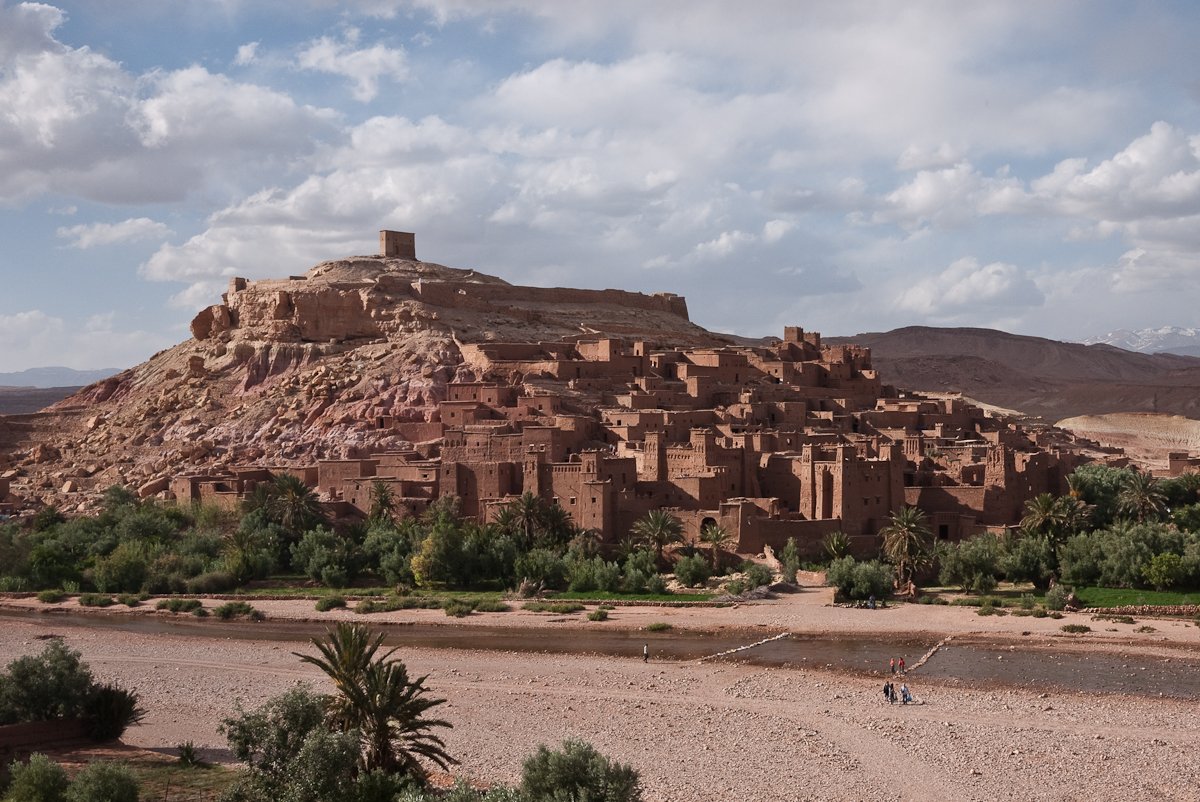
The Atlas Mountains run 740 kilometres across Morocco and hold the homeland of the country’s indigenous people, the Amazigh — known to most travel guides still as the Berber. This is a living culture in a living landscape, and the journey through it deserves more attention than the day-trip from Marrakech that has reduced Aït Benhaddou to a film set.
Cultural travel · UNESCO Cultural Sites · Atlas Mountains, Morocco
It is a quarter to seven in the morning in Imlil, a small town in the High Atlas about an hour’s drive south of Marrakech. A villager walks down the path with three donkeys carrying empty packs. He nods, says something in Tamazight, continues on. Behind him Toubkal rises — at 4,167 metres, the highest peak in North Africa — its summit still holding snow in late April. Marrakech is an hour away. It feels like another country.

The Atlas is not one mountain range but three — High Atlas, Middle Atlas, and Anti-Atlas — covering around fifteen percent of Morocco’s land area and offering the best hiking terrain in Africa north of Kilimanjaro. But the landscape is not the only reason this region matters. The Atlas is Amazigh territory, and travelling through it without engaging with that culture is like travelling through northern Italy without tasting the wine.
Who the Amazigh are — and why the word matters
Most travel guides still use the word Berber. It is an exonym — an outsider’s name — derived from the Latin and Greek “barbarus,” meaning stranger. The people themselves call themselves Amazigh (plural: Imazighen), which means “free people.” It is a name they have used for thousands of years, and the reclamation of identity it expresses is not a small thing. When young Moroccans in 2026 insist on Amazigh over Berber, they are doing something analogous to the way Inuit communities in the Arctic moved away from “Eskimo” as an outsider’s term.
The Imazighen have lived across North Africa for at least five thousand years, well before the Arabs, the Romans, the Phoenicians, and the French arrived. Today they make up between 40 and 50 percent of Morocco’s population. The Tamazight language gained official recognition as a national language in a 2011 constitutional amendment, and since then the Amazigh script — Tifinagh, one of the world’s oldest writing systems still in active use — has appeared on official signage across the country. Arrive in Marrakech airport in 2026 and you see Tifinagh on the signs alongside Arabic and French. This is recent. It is deliberate.
Morocco’s Amazigh are not a single people but several. The Riffians of the Rif Mountains in the north speak Tarifit. The Zayanes of the Middle Atlas around Khenifra speak Tamazight in the narrower sense. The Cheluh (or Shilha) of the Anti-Atlas and the Souss Valley speak Tashelhit and form the largest single group. The languages are related but not mutually intelligible; a man from the Rif and a woman from the Anti-Atlas often switch to Arabic or French when they meet.
Aït Benhaddou — the UNESCO anchor and its double life
Aït Benhaddou is a ksar — a fortified village — built of clay-rich earth on the western bank of the Asif Ounila river at the foot of the High Atlas. It was inscribed on the UNESCO World Heritage list in 1987. The recognition is multi-layered: the architecture itself (one of the best-preserved ksar in southern Morocco), the location along the old caravan route between Sub-Saharan Africa and Marrakech, and the continuity of Amazigh dwelling tradition that the ksar form represents.
By 2026, however, Aït Benhaddou is equally famous as a film location. Lawrence of Arabia was partly shot here. Gladiator too. Game of Thrones used the ksar as Yunkai. International recognition has brought income to the region, but it has also produced visitors who arrive expecting a film set rather than an architectural and cultural monument. The tour companies in Marrakech sell it as “the Game of Thrones location” first and as UNESCO heritage second.
This creates an interesting traveller’s problem. The visitor who arrives knowing what the ksar actually is meets a different place than the one who arrives by tour bus after a mountain pass and a YouTube trailer. The older parts of the village remain inhabited by a small number of Amazigh families. You can walk up through the lanes, climb to the granary at the top — the view across the Asif Ounila valley from there is one of Morocco’s finest — and understand how the ksar actually worked: as defensive structure, as caravan station, as home.
The living cultural landscape
Aït Benhaddou is the anchor, but the larger story is the Amazigh cultural landscape extending across the entire Atlas system. That landscape is not just mountains and earthen towns — it is a complete cultural ecology that continues to function as it always has. Terraced fields cut into mountain slopes. Communal bread ovens where women bake khobz at dawn. Weekly souks in villages like Asni and Tnine Ourika that follow trading rhythms hundreds of years old. Looms in homes where women weave carpets with patterns that mark which tribe they belong to.
One particularly fascinating detail: in the High Atlas, a whistled language called Assinsg still exists. Shepherds communicate over distances of several kilometres using whistles that mimic Tamazight syllables. It is a candidate for UNESCO’s intangible heritage list. The number of people who still master it is small and falling fast — one of those examples where a piece of cultural heritage may disappear within a generation if nothing changes.
A traveller cannot rescue an endangered whistle language, but can do something small and meaningful. Buy directly from artisans rather than through souvenir shops. Pay honest prices for carpets and ceramics. Take a meal in a home rather than at a restaurant serving “Berber food” to tourists. The kind of choices that send money down into the culture rather than into intermediaries.
The 2023 earthquake — and what it means for travelling here now
On September 8, 2023, a magnitude 6.8 earthquake struck Morocco. The epicentre lay in the High Atlas, around 70 kilometres south-west of Marrakech. Roughly 3,000 people died, the vast majority in Amazigh mountain villages where clay-built houses collapsed. Several known villages including Moulay Brahim and Tafeghaghte were severely affected.
By 2026 the rebuilding is well advanced but not complete. Most tourist routes function normally; Imlil and Aït Benhaddou are both open. Many villages have new houses built in a combination of traditional methods and earthquake-resistant construction. This is a good reason to travel here — tourism revenue feeds directly into local recovery, and a visitor to Amazigh villages in 2026 contributes to the genuine return to normality the region is working toward.
It is not a reason to avoid the area. It is a reason to engage with it.
Where to stay
In the mountains: Kasbah Tamadot, owned by Richard Branson’s Virgin Limited Edition group, sits in the Asni valley and is the region’s recognised luxury choice — a former Amazigh palace converted into a 28-room hotel with views to Toubkal. The mid-range includes Kasbah du Toubkal in Imlil (community-owned, with profits supporting local projects) and Riad Atlas Toubkal. For walkers: mountain refuges like Refuge du Toubkal and locally-owned gîtes in villages such as Aroumd and Tacheddirt.
In Ouarzazate as a base for Aït Benhaddou: Le Berbère Palace is the grand-luxury choice, frequented by film stars and crews during productions. Sultana Royal Golf and Berber Lodge are quieter mid-range alternatives. For authentic ksar lodging: Riad Caravane and Dar Mouna in the Aït Benhaddou area itself.
In the Middle Atlas: Michlifen Resort & Golf near Ifrane is the region’s grand-resort. For smaller boutique: Dar Anebar in Ifrane.
Avoid
The day trip from Marrakech to Aït Benhaddou with arrival at 11 and departure at 16. This is the most-sold and least-rewarding format — four hours of driving each way for two hours at a place that deserves more. If your time does not allow two days in the area, choose a different Morocco experience entirely.
The 30-plus-person guided groups moving through Amazigh villages as a single block. They are intrusive to village life and produce an experience that is more logistical than cultural. Choose a smaller private experience — six to eight people maximum, ideally with an Amazigh guide who can facilitate genuine encounters rather than translate scripted performances.
Souvenir shopping in Marrakech’s Jemaa el-Fna area as a way to “support Amazigh artisans.” Most goods sold there as “Berber carpets” or “Berber jewellery” are mass-produced and disconnected from the artisans who make the real things. For real things, buy in the mountains directly from producers — or through established cooperatives such as Anou or Cooperative Tighanimine.
“Berber Night” as the standard hotel-package product. The genuine experience — joining an actual meal in an Amazigh home, hearing music made for the people present rather than for cameras — does not come through a hotel concierge. It comes through a local guide who knows a family willing to invite.
Getting there from the Nordics
TravelTalk is a Nordic-perspective publication. Morocco is a significant outbound destination for our readers in Copenhagen, Oslo, Stockholm and Helsinki, particularly during shoulder seasons. The Atlas has no airport of its own; Marrakech is the natural gateway to the High Atlas, with Casablanca and Fes serving the Middle Atlas.
From Copenhagen: Direct flights to Marrakech with Norwegian, Ryanair, and seasonally SAS. Four hours flying time. To Casablanca direct with Royal Air Maroc, or via Paris/Madrid. From Marrakech airport, transfer to Imlil takes around ninety minutes; to Aït Benhaddou around four hours over the Tizi n’Tichka pass.
From Oslo, Stockholm, Helsinki: Connections via Copenhagen, Frankfurt, Madrid, or Paris. Six to nine hours total travel.
For 2026 specifically: The Tizi n’Tichka pass is open year-round but often snow-covered in winter — driving requires winter experience between December and March. April and May are ideal if you want snow on Toubkal while avoiding the summer heat. Earthquake reconstruction continues, but established tourist routes have normalised.
Practical: Morocco is one hour behind the Nordics in winter, same time in summer. Currency dirham (closed currency — cannot be exchanged outside Morocco). EU citizens have no visa requirement for stays under 90 days. Official languages are Arabic and Tamazight; French is widely spoken in cities; English is found in tourist areas, less so in mountain villages. Mobile phone coverage is reliable on the main routes; less so in higher mountain terrain.
Factbox
UNESCO heritage: Aït Benhaddou (1987). Other Moroccan UNESCO sites with Amazigh connections include the Medinas of Fez, Marrakech and Meknes, Volubilis (Roman ruins in the Middle Atlas), and Essaouira; Telouet kasbah is currently under consideration.
Best season: April-May and October-November for hiking and cultural travel. Summer (July-August) for high-altitude trekking. Winter (December-March) for snow and lower prices, but requires preparation.
How long: Three days minimum for a meaningful impression. A week for genuine immersion — Imlil base with day excursions, Aït Benhaddou overnight, possibly a Middle Atlas stop such as Ifrane.
Toubkal: Highest peak in North Africa, 4,167 metres. Climbable in 2-3 days from Imlil. Not technically difficult in summer, but requires fitness and a local guide.
Languages: Tamazight (in three main dialect groups: Tarifit, Tamazight, Tashelhit). Tifinagh is the Amazigh script, recognised as official alongside Arabic since 2011.
Etiquette: Always ask before photographing people. Dress modestly in villages. Buy directly from artisans rather than through intermediaries. Learn a few greetings in Tamazight (azul = hello; tanmirt = thank you).
More good ideas for the best time of all — your free time
© 2026 TravelTalk.travel / Leisure Media Group Ltd. All rights reserved.
🎬 Watch the films — 365 ways to travel the world Watch →
Eight sites, one family — travel, wine, sport and sharper thinking. Explore the rest of the universe.