
Everything About Camping Holidays: The Complete Guide to Your Next Adventure
There’s something fundamentally liberating about waking up in a tent to the sound of birds, brewing coffee on a camping stove, and having the entire day ahead with no plans except those you make yourself. Camping holidays offer freedom in its simplest and most authentic form – and it’s accessible to everyone, whether you have €500 or €5,000 to spend.
In an era where everything must be planned, optimized, and documented on social media, camping offers the opposite: spontaneity, simplicity, and genuine presence. And it’s damn cheap compared to hotels. But camping is about much more than economics – it’s about a way of traveling that gives you closer contact with nature, local places, and actually also yourself and those you travel with.
Why camping is still relevant (and growing)
Camping has never been more popular. After Covid-19, millions of Europeans discovered what Nordic families have known for generations: camping holidays are fantastic. Campsites experienced record bookings, motorhome sales exploded, and tent pitches from Bornholm to Lake Garda were full all summer.
But why? In a world of all-inclusive resorts and five-star hotels, why do more and more people choose to sleep in tents or motorhomes?
Freedom and flexibility: You set the pace. If the weather is perfect at the coast, you stay an extra day. If a place is boring, you move on. No check-in times, no fixed dinner times, no dress code.
Authenticity: Camping forces you out of the tourist bubble. You shop at local supermarkets, eat where locals eat, see places as they actually are – not through a hotel window.
Economics: A campsite in Tuscany costs €20-40 per night for a family. A hotel in the same location: €150-300. On a 14-day holiday, you easily save €1,500-2,500. That’s an extra vacation next year.
Nature: Your bedroom is in a forest, by a lake, with mountain views, by the sea. How many hotels can offer that without costing a fortune?
Kids love it: Not because there’s a pool and animation (though many campsites have that), but because they can run freely, play with other kids from across Europe, build fires, fish, cycle. It’s childhood as it should be.
Types of camping holidays: find your style
Camping isn’t one thing. It’s a spectrum from ultralight backpacking to glamping with king-size beds and private jacuzzis. Find your style – or try them all.
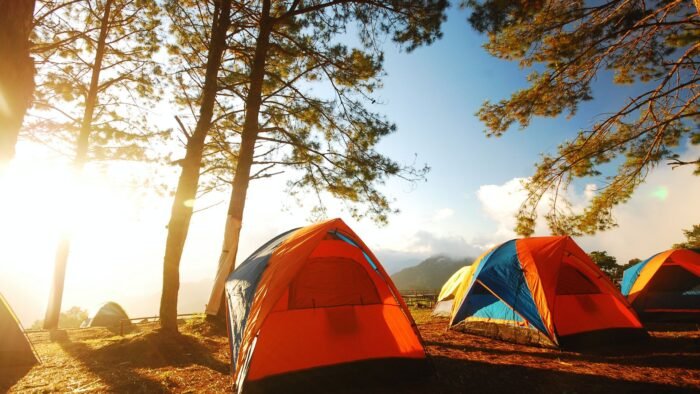
Tent camping (the classic)
The cheapest, simplest, and for many: the most authentic. A tent, a sleeping mat, a sleeping bag, camping cookware. That’s all you need. Tent camping is ultimate freedom – you can pitch a tent almost anywhere (respecting rules and nature), and your gear fits in a large backpack or half a car trunk.
Perfect for: Backpackers, young couples, families with adventure spirit, budget travelers.
Challenges: Weather can be a factor (rain in a tent isn’t optimal), comfort is limited, toilet facilities are what the campsite offers.
Costs: Equipment €300-1,000 (lasts for years), campsite €10-30/night.
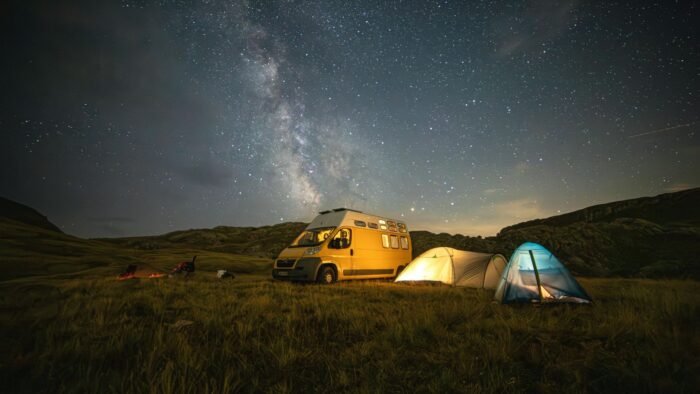
Motorhome/caravan (comfort on wheels)
Your home follows along. Kitchen, bathroom, beds, storage – everything you need. Motorhomes give tent freedom with significantly more comfort. You can wake up, make breakfast, drive 3 hours, park at a beach, make lunch, drive on, find a campsite, make dinner and watch a movie on the sofa. All in the same day.
Perfect for: Families, couples 50+, those who want to combine freedom with comfort, longer trips.
Challenges: Purchase/rental cost is significant, fuel costs, not all places are accessible for larger vehicles.
Costs: Rental €600-1,500/week, campsite €25-50/night (incl. electricity).
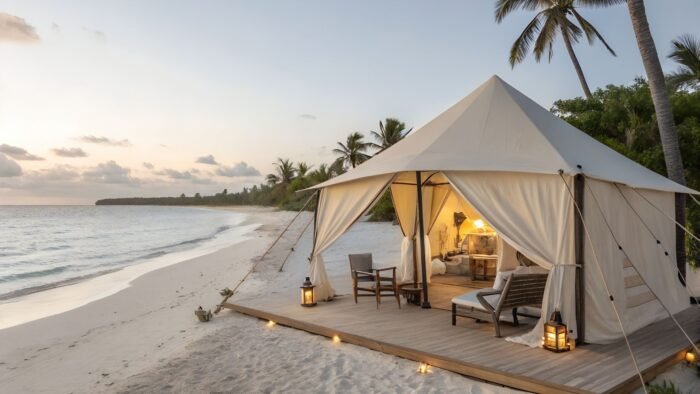
Glamping (camping for those who don’t camp)
Glamorous camping – pre-set tent or cabin with real beds, electricity, often private bathroom. Camping atmosphere without the logistics. Perfect introduction to camping life for skeptics.
Perfect for: Camping beginners, couples who want to try it, families with very young children.
Challenges: More expensive than normal camping, less authentic experience, must be booked far in advance.
Costs: €50-150/night depending on level.
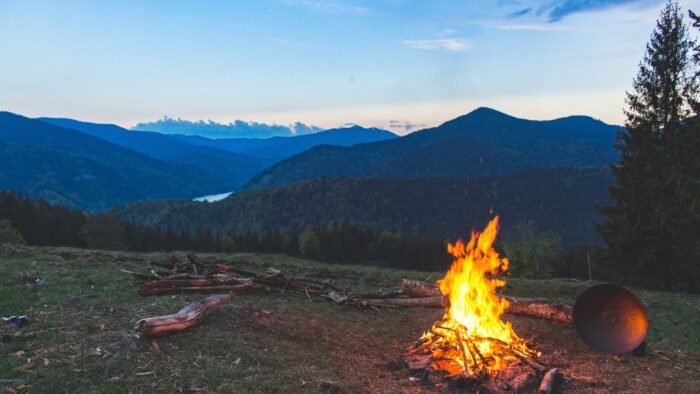
Wild camping (for adventurers)
In Norway, Sweden, Finland: freedom to roam gives you the right to pitch a tent in nature. No campsite, no facilities, just you, your tent, and nature. The most intense and least comfortable, but also the most memorable.
Perfect for: Experienced outdoors people, those seeking solitude, photographers, nature lovers.
Challenges: Requires experience, proper equipment, ability to navigate, respect for leave-no-trace principles.
Costs: Virtually free (after equipment investment).
Your first camping gear: what you really need
Let’s be honest: you don’t need to buy Fjällräven expedition gear for €5,000 to sleep one night in a tent. Start simple, upgrade when you know you love it.
Tent camping essentials (basic budget: €500)
Tent: €150-300 for a decent 3-4 person tent. Nordisk, Outwell, Coleman are good brands. Choose one with good water column (min. 3000mm) and proper ventilation. Test it in the garden before leaving.
Sleeping bags: €30-80 per piece. Comfort temperature must match destination and season. For summer camping in Southern Europe: 10-15 degree rating. For Scandinavian summer: 0-5 degree rating.
Sleeping mats: €20-60 per piece. Self-inflating are comfortable, foam mats are cheap and indestructible. Don’t skip this – hard ground isn’t fun.
Cooking equipment: €30-100. A trangia or gas burner, pot, pan, cutlery, plates. Remember matchstick-proof storage.
Cooler bag/coolbox: €20-150. Electric coolbox is gold on campsites with electricity. Passive cooler bag with ice blocks works for shorter trips.
Camping chairs and table: €50-150 for set. The difference between sitting on the ground and sitting comfortably in the evening is enormous.
Lights: €20-50. Headlamps for everyone + a camping lantern for tent/table area.
Nice-to-have (when you’re hooked)
Tarp (tarpaulin for extra shelter), hammocks, solar panel for charging, proper knives, thermos flasks, portable speakers, camping bathtub for kids, extra powerbanks, water carriers.
Campsites vs. wild camping: what suits you?
Campsites (the safe start)
Facilities: toilets, showers, kitchen, often pool, playground, restaurant/shop. Perfect for families, beginners, or just when you want comfort. Danish campsites have world-class facilities – clean, modern, well-maintained.
Social aspect: Kids find friends in minutes. You meet Dutch, German, Swedish families. Spontaneous campfire evenings emerge, where someone has a guitar, others wine, and kids play until 11pm because it’s vacation.
Booking: High season (July-August) requires advance booking. Rest of the year you can often just show up. Apps like Park4Night, Campercontact, Pincamp help find sites.
Wild camping (for the adventurous)
Freedom to roam in Norway/Sweden/Finland gives you the right to overnight in nature (respecting private land, cultivated fields, nature). It’s free, beautiful, intense – and requires more preparation.
Rules: Min. 150m from nearest house. Leave no trace. Take your waste. No open fire if fire danger. Respect nature.
Logistics: You must carry everything yourself or have 4WD vehicle for remote spots. No toilet means proper spade work. No water means you carry it or filter from streams.
Camping destinations: where the magic actually happens
Let’s drop the generic list. Here are destinations I actually recommend – with concrete details about why they’re special, what you should do there, and who they suit.
Bornholm: Denmark’s answer to the Mediterranean (but with better campsites)
Yes, I know – Bornholm sounds boring when the alternative is Croatia. But hear me out: Dueodde has beach sand so fine it feels like powdered sugar between your toes. At Hammershus campsite you wake up with views over a 700-year-old castle ruin and the Baltic Sea. In Gudhjem you can buy smoked herring directly from the smokehouse at 7am and eat it at the harbor while local fishermen come in.
Bornholm is perfect first camping holiday because: language is Danish (no stress), facilities are world-class, weather is better than rest of Denmark (microclimate), and if things go wrong you can be home in 4 hours. Plus: round churches, Svaneke town, Almindingen forest for cycling. It feels exotic enough to be vacation, safe enough to relax.
Best for: First camping attempt, families with small kids (2-8 years), grandparents with grandchildren.
Season: June-August (July is packed), May and September are beautiful but cool for swimming.
Pro tip: Book Sandvig Camping if you want beach right outside. Bornholms Familiecamping if kids need to entertain themselves.
Lofoten: Where the planet shows off
Lofoten isn’t a camping holiday – it’s a pilgrimage for people who love nature. Imagine: jagged mountains (so sharp they look like teeth) rise directly from turquoise-blue sea. Midnight sun means you can hike at 11pm, make dinner at 1am, and sleep when you feel like it. Roads wind between fishing villages with red rorbuer cabins, white beaches (Haukland, Uttakleiv), and views that make you stop the car every five minutes.
But let’s be honest: Lofoten isn’t easy. It rains. Often. Weather changes in 20 minutes from sunshine to storm. Campsites are basic (toilets, showers, not much more). It’s expensive – a pizza costs €15, campsite €25-50/night. And you have to drive far (or fly to Bodø/Svolvær).
But if you can handle it? It’s the most beautiful place you’ll ever sleep in a tent. When you stand on Reinebringen peak after 2 hours climbing and see all of Lofoten stretching below you – that’s when you understand why Norwegians spend 40% of their vacation budget on outdoor gear.
Best for: Nature enthusiasts, photographers, couples without small kids, experienced campers.
Season: June-August (midnight sun), September (northern lights begin, fewer tourists).
Pro tip: Use freedom to roam – free camping far from roads is magical. Ramberg Gjestegård camping has good location between beaches.
Lake Garda: Where Italian dolce vita meets the Alps
Lake Garda is camping’s Disneyland – in the best sense. Huge camping resorts (Bella Italia, San Biagio) with waterparks, entertainers, restaurants, supermarkets. But also small, quiet sites (Camping Garda in the north) where you hear mountain streams and make pasta on camping stove with lake views.
What makes Lake Garda perfect? Options. Want to windsurf? Torbole has Europe’s best conditions. Hiking? Monte Baldo has trails for all levels. Culture? Sirmione has Roman ruins and gelato. Adrenaline? Gardaland (theme park) is 20 minutes away. Local vibe? Malcesine old town has small osterie where you eat risotto con pesce and drink Lugana white wine at €3 per glass.
It’s not cheap (€30-50/night for standard pitch in high season), but you get value: Warm weather guaranteed May-September, pool when kids get bored, activities 24/7. It’s camping holiday on easy mode – but it works.
Best for: First foreign camping, families with kids (all ages), active couples, multigenerational trips.
Season: May-June (perfect weather, fewer people), September (warm water, cheaper).
Pro tip: North end (Riva, Torbole) is active/sport vibes. South end (Sirmione, Desenzano) is beach/culture vibes. Choose by personality.
Småland, Sweden: Pippi Longstocking land is real
Småland isn’t dramatic. There are no mountain peaks, no famous monuments, no Instagram hotspots. It’s just… beautiful. In the way only Sweden can be beautiful: Red wooden houses by crystal-clear lakes. Endless forest roads perfect for cycling. Blueberries and chanterelles you can just pick. Campsites where kids run around barefoot from breakfast to sunset because it’s 100% safe.
Here’s why Småland works for families: Kids can be independent. They find other kids (always Swedish/German/Dutch families), they learn to row canoes, they build fires with the other kids, they fish pike from the dock. Parents can sit with coffee and book because they can see the kids, but the kids aren’t playing with them anyway.
Plus: It’s cheap. Campsite €20-35/night. Coop supermarket has salmon for €5, strawberries for €2. Activities are free (hiking, swimming, cycling, fishing). Astrid Lindgren’s World (theme park) if it rains, but otherwise you don’t need to pay for anything.
Best for: Families with kids 4-12 years, people who want to relax TF, budget-conscious, first international camping.
Season: June-August (Midsummer is magical), July is high season.
Pro tip: Västervik archipelago (island camping with boat access), Åsnen national park (canoe paradise), Vimmerby area (Astrid Lindgren land).
Istria, Croatia: Mediterranean before it got overtouristed
Istria is Croatia’s best-kept secret. While everyone drives to Split/Dubrovnik in the south, smart travelers overnight in Istria in the north (the peninsula sticking out toward Italy) know: Rovinj is just as beautiful as Venice, just without crowds. Poreč has 1500-year-old Byzantine mosaic basilica that blows minds. Beaches are stone-pebble (not sand), but water is so clear you see 10 meters down. And every small village has a konoba (local restaurant) where you eat fresh fish, homemade pasta, Istrian truffles, and drink Malvazija white wine that costs 80 kuna (€10) per bottle at supermarket.
Campsites range from basic (Camping Lanterna – Europe’s largest, 5000+ pitches, like a city) to boutique (Camping Mon Perin with private stone beaches). Prices are reasonable (€25-45/night), facilities modern, and locals are friendly without being fake-tourist-friendly.
Challenge? It’s popular among Germans/Austrians/Italians, so July-August is packed. And heat can be brutal (35+ degrees). But May-June and September are perfect – 25-28 degrees, half as many tourists, water still 22-24 degrees.
Best for: Families with tweens/teens, couples, food lovers, first Balkan experience.
Season: May-June (blooming, empty), September (autumn gold, locals back).
Pro tip: Rovinj side = culture + beaches. Pula side = Roman amphitheater + working town vibe. Lim fjord = canoe/kayak. Eat konoba, not tourist restaurants.
Scotland Highlands: For those not afraid of rain
Let’s start with facts: It rains in Scotland. A lot. If you can’t handle wet tent, wet clothes, wet firewood – go to Italy instead. But if you can? Highlands offer something nowhere else in Europe has: raw, untamed wilderness just 2 hours flight from Denmark.
Wild camping is legal (Scottish Outdoor Access Code). That means you can pitch tent at Loch Lomond, wake up to mist over water, make porridge while red deer graze 50 meters away. Drive North Coast 500 (Scotland’s answer to Route 66) and stop where you want – by waterfall, in heather-covered moors, with view over Outer Hebrides.
Isle of Skye is mandatory: Fairy Pools (crystal pools you can swim in if you’re hardcore), Old Man of Storr (hike to bizarre rock formation), Neist Point (lighthouse on cliff edge). But rest of Highlands – Glencoe, Fort William, Cairngorms – are equally beautiful and have fewer tourists.
Challenges? Midges (tiny biting flies) June-August are HELL. Seriously, they ruin evenings. Buy midge net for head. Weather is unpredictable – 4 seasons in one day. Infrastructure is sparse – fuel up when you can, buy food in larger towns. But for people who want off-grid experience in Europe? Nowhere better.
Best for: Experienced campers, adventurous couples, photographers, people who love hiking and hate crowds.
Season: May (spring flowers, no midges), September (autumn colors, fewer midges).
Pro tip: Download Maps.me with offline maps. Take gore-tex everything. Bring whisky and chocolate – campfire essentials. Wild camp responsibly.
Practical: what does a camping holiday actually cost?
Let’s calculate a 14-day camping holiday for a family of 4 (2 adults, 2 children 6 and 10 years) in Italy (Lake Garda area).
Scenario 1: Budget tent camping
Transport: Own car, fuel DK-Lake Garda return: €500
Campsite: 14 nights à €25 (standard pitch, basic): €350
Food: Self-catering breakfast/lunch, restaurant 2x/week: €800
Activities: Admissions, bike rental, excursions: €300
Misc: Ice cream, gas for cooking, small items: €150
TOTAL: €2,100
Scenario 2: Comfort motorhome
Motorhome rental: 14 days high season: €1,400
Fuel: €500
Campsite: 14 nights à €40 (with electricity): €560
Food: Mix self-catering/restaurant: €1,000
Activities: €400
Misc: €200
TOTAL: €4,060
Comparison: Hotel/all-inclusive
Same family, same destination, hotel with half-board: €3,500-5,000 just for hotel + flight. Activities and extra food: +€1,000. Total: €4,500-6,000.
Camping saves you €2,500-4,000 on one vacation. That’s two camping holidays for the price of one hotel holiday.
Camping with kids: paradise or nightmare?
Both. But mostly paradise if you do it right.
Honest talk: the challenges
Kids in tents can be tough. They wake up when the sun rises at 5am. They need to pee in the middle of the night. If it rains, everyone is tired and grumpy. Teenage daughter might prefer hotel with pool and WiFi over tent with mosquitoes.
Small children require more logistics – diapers, food preferences, nap needs. Teenagers require WiFi, charging options, privacy.
But: why it works anyway
Kids love camping if they get to be kids. Run freely, play in mud, build fires, fish, meet other kids, bike freedom, get dirty, stay up until 11pm because it’s vacation.
Do it right: Let kids pack their own backpack with favorite toys. Give them responsibility (collect firewood, help with tent, make breakfast). Let them choose some activities. Accept they’ll get dirty – that’s the point.
Pro tips: Headlamps are magical for kids. Choose campsites with playground/pool. Take cards/board games for rainy days. Marshmallows on fire are mandatory. One night in motorhome/cabin mid-tent holiday gives a break.
Camping etiquette: don’t be that family
Campsites are communities. Small rules make it good for everyone.
Noise: 11pm is cut-off. No loud music, loud conversations, partying. Kids screaming at 7am – ok. Adults partying at 2am – not ok.
Space: Your area is your area. Don’t invade neighbor’s space with your things, kids, or dog without invitation.
Facilities: Shared toilets: clean up after yourself. Shared kitchen: tidy up immediately. Waste sorting: follow rules.
Dogs: On leash unless dog park. Pick up dog poop always. Not everyone loves your dog – respect that.
Children: They can play and make noise – but if they terrorize the neighbor, it’s your responsibility to stop it.
Seasons: when should you go?
High season (July-August)
Advantages: Guaranteed warm weather (South/Central Europe), all facilities open, many families – kids find friends easily.
Disadvantages: More expensive (25-50% higher prices), crowded campsites, book months ahead, heat can be extreme (35+ degrees), tourist attractions overcrowded.
Shoulder season (May-June, September)
Advantages: 30-40% cheaper, fewer people, more pleasant temperatures, beautiful nature (May flowers, September autumn colors), local atmosphere.
Disadvantages: Some facilities closed, weather more uncertain, water still cold for swimming (May/June Southern Europe ok, Northern Europe cold).
Low season (March-April, October-November)
Advantages: Cheapest, no crowds, authentic, possibility for long stays cheaply.
Disadvantages: Cold in North/Central Europe, many campsites closed, short days (dark at 5pm), rain likely.
Winter camping (December-February)
For hardcore enthusiasts. Ski camping in the Alps or Norway. Northern lights hunting in Northern Scandinavia. Requires special equipment (4-season tent, warm sleeping bags -20°C rating, proper clothing). Magical but demanding.
Apps and tools that make camping easier
Find campsites: Campercontact, Park4Night, Pincamp, ACSI Camping Europe, Cool Camping
Navigation: Google Maps (offline downloads important), Maps.me (hiking trails), Komoot (bike/hike routes)
Weather: YR.no (Norwegian, very accurate), Windy (wind/rain forecast), Weather Underground
Activities: AllTrails (hiking), Wikiloc (routes with GPS), local tourism apps
Language: Google Translate (offline packs), Duolingo (learn basics before departure)
Packing lists: PackPoint, Camping Checklist apps
Conclusion: why you should try it
Camping isn’t for everyone. If you need aircon, room service, and fancy room interior to relax – book a hotel. Nobody judges you.
But if you’re curious about a different way of traveling – one that gives you freedom, authenticity, contact with nature, teaches your kids independence, saves you money, and creates memories that last a lifetime – give camping a chance.
Start simple. A weekend at a Danish campsite with rented equipment. If it works, try a week in Sweden with own tent. If you love it, invest in proper gear and go to Italy, Croatia, Norway.
What’s the worst that can happen? You find out camping isn’t for you, and you’ve had a cheap vacation. What’s the best that can happen? You discover a lifestyle that transforms how your family travels, and you have decades of adventures ahead.
There’s a reason camping families return year after year. Not because it’s perfect, but because it’s real. And in a world of filtered Instagram vacations and all-inclusive isolation, “real” is a luxury worth investing in.
Pack the tent. Hit the road. Experience it yourself.s. This is your first post. Edit or delete it, then start writing!