
From the traveltalk.dk family – started in Denmark in 2018
Read in: Dansk (original) · Deutsch
Travelling to France – seven holidays in one
France is not one travel destination. It is at least seven. The Loire Valley in spring, a vineyard in Burgundy in autumn, a lavender field in the Luberon in June, a piste in Val Thorens in February, a café on the Place des Vosges in Paris on a rainy Wednesday, an oyster bar in Cancale on a blustery morning, a restaurant in Lyon where the older men have been drinking the same aperitif for thirty years. Each of them is France. Each of them calls for a slightly different trip.
That is what makes the country hard to summarise — and what keeps most Danish travellers who get to know France coming back again and again. You never quite finish with it. You simply discover more of its versions.
Our guide here is an attempt to map what is actually out there — region by region, season by season, with the names of hotels and restaurants you can book, and with practical details on how to get there from the Nordics, what things cost, and where to avoid the rookie mistakes.
📄 Trip facts for travelling to France
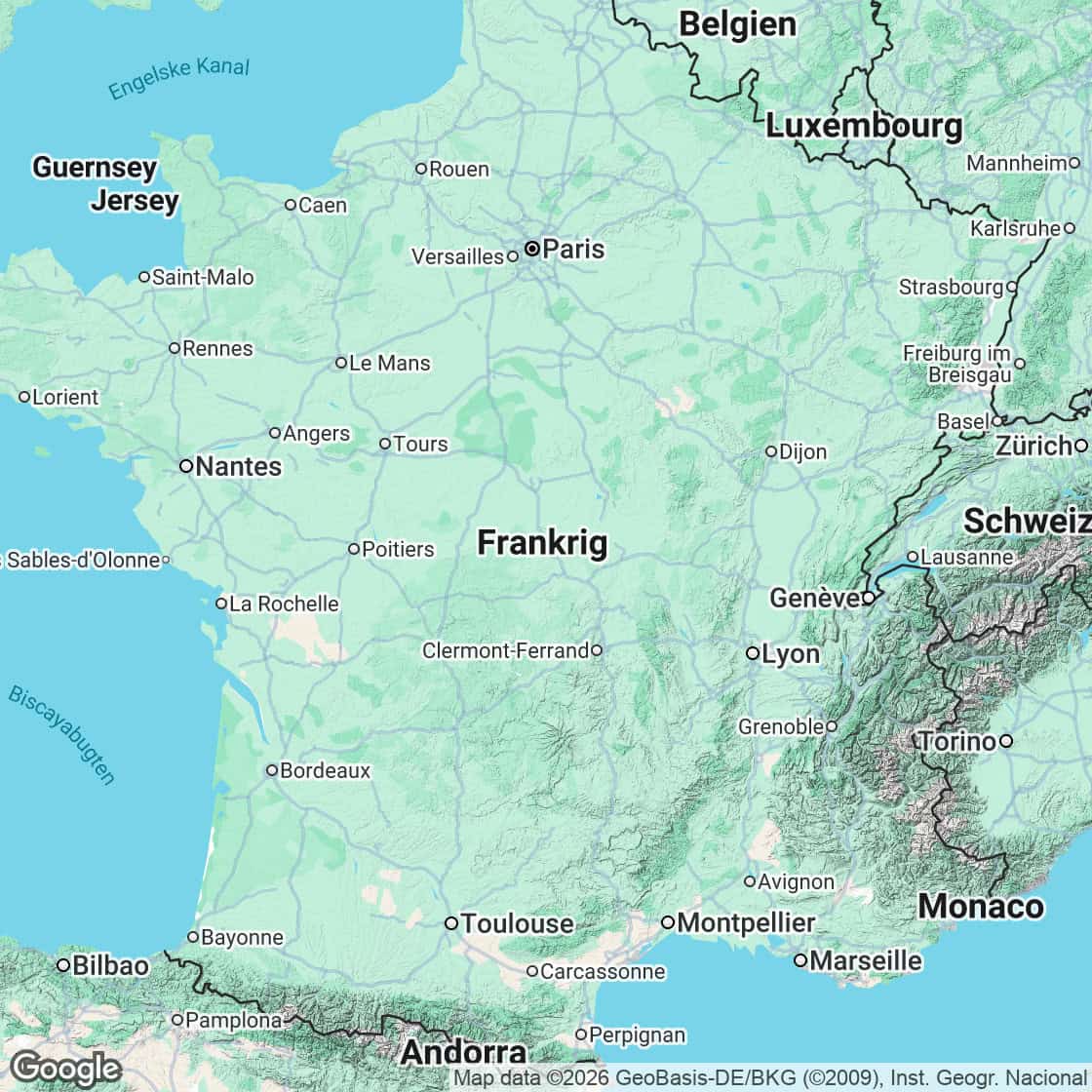
- Location: Western Europe — the Atlantic to the west, the Mediterranean to the south, the Alps and Pyrenees as natural barriers to the east and south-west
- Capital: Paris
- Language: French — English is widespread in tourist areas and noticeably less so in the provinces
- Currency: euro (EUR)
- Regions: 13 on the mainland, each with its own cuisine, climate and pace
- Best season: April–June and September–October for cities and culture, June–September for the coast, December–March for skiing. September is statistically the country’s best month to travel
- Recommended trip length: 5–7 days for one region
- ✈️ Departing from: Copenhagen Airport (CPH) — direct to Paris year-round and to Nice, Marseille and Bordeaux in season. From there, the TGV continues between the major cities in under half the journey time
💡 Traveltalk tip
Choose one region, not three. France is not one holiday destination, it is at least seven, and the TGV makes it dangerously easy to believe you can reach them all. You cannot. The Loire, Burgundy, Provence and Brittany are four different countries, each with its own cuisine and rhythm, and the pleasure of them lies in repetition — the same market on Tuesday, the same café, the same waiter who eventually knows what you drink.
Insider tip: eat where the locals eat. A bistro with a handwritten daily menu and full tables in the middle of the lunch break usually serves better food than the restaurant next door — for a third of the price. And if you are going on a winery visit, book ahead: the big Burgundy estates are closed to outsiders, but serious houses such as Maison Joseph Drouhin and Maison Bouchard welcome visitors when you have arranged it in advance.
🤝 Travel partner — the spot is free. This is where we recommend travel partners: Who can deliver the trip or simply accommodation/transport? Do you organise trips to France? The spot could be yours — write to us at hello@leisuretalk.net.
Why France — four foundations
World-class culture and history
France has nearly 40 UNESCO World Heritage Sites, over 8,000 museums, and a cultural history stretching from the cave paintings at Lascaux to the contemporary art of the Pompidou Centre. The Louvre and the Musée d’Orsay in Paris are the classics, but it is often the smaller collections that leave the strongest impression: the Musée Marmottan Monet in the 16th arrondissement with Monet’s late Water Lilies series, the Fondation Maeght in Saint-Paul-de-Vence with Miró and Giacometti, or the Centre Pompidou-Metz for modern art without the crowds of Paris.
Read our guide to the Louvre and Versailles for the obligatory visits, and the guide to Paris’ museums for the rest.
Gastronomy as UNESCO-protected heritage
In 2010, the French meal was added to UNESCO’s list of intangible cultural heritage. Not for the sake of the dishes alone, but for the ritual itself — the long lunch, the placement of the wine, the discipline of dessert. It remains the daily practice in France, not a gastronomic attraction. The markets — Saturdays in Sarlat, Tuesdays on the Place Richelme in Aix-en-Provence, Wednesdays at the Marché Bastille in Paris — are where you meet the culture, not in the starred restaurants (though there are plenty of those too).
Brittany has crêpes and shellfish. Provence has olive oil and herbs. Burgundy has beef and deep red wines. Alsace has a German undercurrent with choucroute and Riesling. Our guide to French food takes the regional cuisines one by one.
Wine — the country’s parallel geography
France makes finer wine than any other nation. Burgundy, Bordeaux, Champagne, the Rhône, the Loire, Alsace, Languedoc, Provence — each district with its own tradition, its own grapes, its own classification systems. For the Danish wine traveller, the combination of region and estate is the strongest argument for going to France at all: you can taste a Domaine de la Romanée-Conti where the grapes are grown, you can visit Maison Krug in Reims, you can stay on an estate in Bandol and drink Mourvèdre with the winemaker himself.
Read our guide to the French wine regions and French wine at winetalk.dk for the deeper detail.
Landscapes that change every hundred kilometres
Few countries pack France’s natural range into such a small area. The Alps to the south-east — world-class skiing and summer hiking. The Atlantic coast to the west — surf and rugged cliffs in Brittany, long flat beaches in Aquitaine. The Mediterranean coast with the Côte d’Azur, the white horses of the Camargue and the inland hills of Provence. The Pyrenees to the south. The Loire Valley in the middle, with its river and hundreds of châteaux. Burgundy with its vine-covered hills. Each region feels like a different destination.
Understanding the French regions in 20 minutes
Paris and Île-de-France
Paris is not a weekend city. It is a country in its own right, divided into 20 arrondissements, each with its own character. The 6th (Saint-Germain-des-Prés) for bookshops and café life, the 11th for young restaurants and nightlife, the 16th for quiet wealth and museums, the 7th for the Eiffel Tower and diplomacy. Versailles is an afternoon trip from the centre, Fontainebleau a quieter counterweight.
For a first visit: 5-7 days, stay in the 6th or 7th arrondissement, walk where you can, take the metro to Montmartre and Père Lachaise. Paris guide.
Provence
Provence is inland south-east France — Aix-en-Provence, Avignon, the Luberon, the Camargue, Les Baux. These are the landscapes of Cézanne and Van Gogh, the lavender fields that peak in July, the winemakers of Bandol and Châteauneuf-du-Pape, and a food culture built on olive oil, garlic, herbs and fish from the Mediterranean. April to May is the best season; July and August are too hot and too crowded.
Read our guide to Provence and — if Périgord is on the cards — our comparison of Périgord and Provence in spring.
Côte d’Azur (the French Riviera)
Beaches, glamour, art. Nice as the authentic base (far cheaper than Cannes and more realistic than Saint-Tropez), Èze for the view over the Mediterranean, Antibes for Picasso’s museum and a less crowded rhythm, Cap Ferrat for the stern villas that never appear on postcards. The cooking here is strongly Italian in character — you will find pissaladière, socca, gnocchi alla nizzarda.
Hotels worth knowing: the Hôtel Negresco in Nice (classic Belle Époque on the Promenade des Anglais), and La Chèvre d’Or in Èze (Relais & Châteaux, panoramic views). More on Nice, Cannes, and Saint-Tropez.
Burgundy and the Loire Valley
Two regions in central France, often combined into one trip. Burgundy is the heartland of wine — Beaune as its capital, the Côte de Nuits and Côte de Beaune as its two grand cru axes, and classic houses such as Maison Joseph Drouhin and Domaine Faiveley. The Loire Valley is the castles — Chambord, Chenonceau, Amboise, Azay-le-Rideau — and a quiet river culture around the city of Tours. Both regions are ideally suited to a four- to six-day driving tour.
Our guide to French castles and castle holidays covers both the Loire and the rest of the country’s château architecture.
The French Alps
Between Geneva and Nice lie some of the world’s largest ski areas. Val Thorens as the highest ski resort in Europe (2,300 m, with snow forecasts often reaching into May), Tignes for the shared Val d’Isère area, Chamonix for the historic mountain setting beneath Mont Blanc, Méribel for family skiing, Courchevel for the exclusive end of the market. In summer the same mountains become one of Europe’s finest hiking destinations — the Tour du Mont Blanc route (around 170 km over 10-12 days) is the classic.
Read our guide to Val Thorens and Tignes.
Brittany and Normandy
The northern Atlantic coast. Rugged cliffs, lighthouses, apple orchards and cider, and seafood of the very finest quality. Brittany has its own Celtic identity, with its language, music and festivals, and a coastline stretching 2,700 km. Mont-Saint-Michel, on the border with Normandy, is one of France’s most visited sights; stay in Saint-Malo or Dinard and drive there early in the morning. Normandy is camembert country and home to calvados, and it is where the 1944 landing beaches lie (Omaha Beach, Utah Beach, and the museum in Caen).
South-west France: Périgord, Aquitaine, Bordeaux
Less visited by Danes than the south-east of France, but culinarily one of the country’s strongest regions. Périgord is known for truffles, foie gras and walnuts, and for its gentle château culture. Bordeaux is of course famous for wine, but the city itself is worth the trip too: a UNESCO World Heritage city centre with beautiful 18th-century façades. Saint-Émilion, an hour east of Bordeaux, is picturesque and easy to visit on a day trip. Our comparison of Périgord and Provence goes into the differences in depth.
France as a sporting trip
Few countries have as many events that people travel for. The Tour de France is the biggest, and the cheapest to watch, since the roadside is free; the route and stages determine where to stand, the scenery along the way is half the experience, and there is also a view from the deckchair. Le Mans runs for 24 hours straight in June, this year too. Roland Garros is played on clay in May and June, and the Paris Masters is played indoors in November. The Rugby World Cup and the Summer Olympics in Paris have both left their mark on the cities, which can still be visited; the 2024 Games rebuilt the entire Seine waterfront.
For golf travellers, France is underrated: the courses lie close to both coast and mountains, Evian Resort on Lake Geneva is a major venue for the women’s game, the town of Évian-les-Bains combines spa treatments and luxury in one package, and Halcyon Retreat, between Nantes and Lyon, is the quieter alternative.
Across France
Some trips don’t pick a single region. Camping is France’s own holiday style, with over eleven thousand sites, and the cheapest route to the most expensive views. If you just need somewhere to start, there are the best places to visit and the journey from Paris to Biarritz. With children, Disneyland Paris is a trip in itself: the park and the family holiday each have their own guide. And if you have ever wondered why the sea looms so large in the French sense of self: Jacques Cousteau was French, and Mayotte in the Indian Ocean is still France. We have also written about the official tourist office.
Season: when you travel changes everything
France is not the same all year round, and choosing the right season is perhaps the most important decision you make after choosing your region.
April to June is the best time for Provence and the Loire Valley. The weather is pleasant, there are flowers, and there is no summer crush. These are also good months for Paris and Burgundy. For a beach holiday, the sea is still too cold in most places.
July and August are the coastal months. The Côte d’Azur, Brittany and the Atlantic coast are at their best. BUT the tourists are all there, restaurants are fully booked, and the roads are jammed. Many of France’s favourite spots shut down around 15 August, much as they do for Ferragosto. Avoid these two months if you can.
September and October are the unquestionably best time. It is the grape harvest in Burgundy and Bordeaux, there are fewer tourists, the light is still fine, and the water on the Mediterranean coast is still warm. If anyone asks when to travel to France once a year, this is the answer.
November to March suits the cities (Paris, Lyon, Marseille without the queues) and skiing in the Alps. The coastal regions are quiet. The truffle season in Périgord peaks in January and February.
France from the Nordics: the practicalities
Most Danish trips to France are by air. The European rail network links Copenhagen to Paris via Hamburg, Cologne and Brussels in about 14 hours, for those who prefer it. Driving is an option for summer trips to the coast (Esbjerg to Calais by ferry, or the whole way by road), but it takes three days of driving from Zealand to Provence.
Paris has direct flights from Copenhagen with SAS, Air France and Norwegian, with several departures daily and roughly 2 hours in the air. CDG (Charles de Gaulle) is the main airport; ORY (Orly) is smaller and often better for low-cost airlines.
Côte d’Azur has direct flights from Copenhagen to Nice (NCE) with SAS, often several times a week. Norwegian operates seasonally. The flight takes about 2 hours 30 minutes. From NCE it is 30 minutes to Cannes by train, and 40 minutes to Monaco.
Provence has direct flights from Copenhagen to Marseille (MRS) with SAS all year round. From MRS it is 30 minutes to Aix-en-Provence, 1 hour to Avignon, and 1 hour 15 minutes to Gordes in the Luberon.
Bordeaux — direct flights from Copenhagen with SAS in season (spring and autumn), otherwise via Paris or Amsterdam. Around 2 hours 45 minutes direct.
Lyon (LYS) and Toulouse (TLS) — typically via Paris or Amsterdam. Lyon is a particularly good gateway to Burgundy (TGV connection to Beaune in under an hour).
The Alpine ski areas — fly to Geneva (GVA, direct from Copenhagen) or Lyon, then allow around 2-3 hours by transfer bus or car to Val Thorens, Tignes or Chamonix.
For our Nordic neighbours: Oslo, Stockholm and Helsinki have direct routes to Paris and Nice. For other destinations, a connection via Paris is usually the most convenient. Finnair and SAS cover most of it; KLM via Amsterdam and Lufthansa via Frankfurt or Munich are good alternatives.
In France: The TGV network is among the best in Europe — Paris to Marseille in 3 hours, Paris to Bordeaux in 2 hours, Paris to Lyon in 2 hours. Within regions, a car is often necessary (the Loire Valley, Burgundy, Provence). Watch out for low-emission zones (“Crit’Air” zones) in Paris, Lyon and other major cities — certain diesel vehicles are not permitted in city centres, and any fines will find their way to you back in Denmark. For practical planning and an overview of regional resources: Atout France — the official French tourist information service.
FAQ – France
What is the best time to travel?
For cities and culture: April to June and September to October. For a coastal holiday: June to September (though July and August are overcrowded). For a ski holiday: December to March. For a truffle trip to Périgord: January to February. For a wine trip to Burgundy: September (the harvest) or May.
Is France expensive?
Mid-range overall. Paris and the Côte d’Azur are expensive — budget 1,500-2,500 kroner per person per day including mid-range hotels, restaurants and transport. Provence, the Loire Valley, Brittany and Périgord are cheaper — 1,000-1,500 kroner per day.
Which regions should first-time visitors choose?
Paris (3-5 days) plus a regional week in Provence or the Loire Valley. That covers the country’s two most distinct faces without becoming superficial.
How do you get around France?
TGV trains between major cities (book via SNCF Connect or Trainline). A car is necessary in the Loire Valley, Provence, Périgord and the Alps. Always check low-emission zones in cities before driving in.
Is France family-friendly?
Very much so. Especially Provence, the Loire Valley (many châteaux are family-friendly), the Côte d’Azur (beaches), the French Alps (skiing and summer walking), and Disneyland Paris if that’s your thing.
Where can you find the best wines?
Burgundy, Bordeaux, Champagne, the Rhône and the Loire are the classics. Provence (rosé) and Alsace (Riesling, Gewürztraminer) are underrated. Read our wine guide for the deeper detail.
Hidden gems:
- Annecy (the Alps’ “Little Venice”, underrated)
- Île de Ré (Atlantic island, cycling holidays in pure countryside)
- Colmar (Alsace half-timbered houses, wine route)
- Èze (the clifftop village between Nice and Monaco)
- Sarlat (medieval Périgord town, truffle market)
Selected trips to France.
Traveltalk has over 50 travel suggestions for France. Here are a few of the most popular:
- Paris — our guide
- Provence — our guide
- Périgord and Provence in the spring
- French wine regions
- French food — the regional cuisines
- French castles and castle holidays
- Skiing holidays in France
Ready for France?
France is a country you return to again and again — for the atmosphere, for the flavours, for finding the next village you didn’t know existed. Use this guide as your way in, and dive into the regional guides for the deeper detail. We update the content on an ongoing basis.
France in English
French wine and French food
Bon voyage.