
Italy has started rationing itself, and that changes how you book
Italy holds 61 UNESCO World Heritage sites — more than any other country on earth, ahead of China by one. In 2025 it recorded roughly 185 million arrivals in its accommodation, up 7.1 per cent on the year before, with international arrivals rising 8.7 per cent to more than 104 million. Both numbers are records. Put them together and you have a country with the densest concentration of things worth seeing anywhere, being visited harder than at any point in its history.
The consequence is the single most useful thing to understand before you go. Italy has begun formally rationing access to itself. Venice charges day-trippers to enter the city on around 60 named dates a year. The Colosseum, the Uffizi, the Accademia and Leonardo’s Last Supper are all timed-entry with named tickets, and the good slots go weeks out. Florence has moved against new short-term lets in its historic centre. None of this is hostile — it is a country of 59 million people managing three times that many visitors — but it does mean one thing plainly:
Italy is no longer a country you can improvise. The quality of an Italian trip is now largely decided at the booking stage, four to eight weeks before you fly, and almost not at all once you arrive. That is the opposite of how Italy is usually sold to you, and it is the thing this guide is built around.
📄 Italy: the quick facts
- Where: the Italian peninsula from the Alps to Sicily, plus Sardinia and around 450 smaller islands
- Capital: Rome
- Structure: 20 regions, five of them autonomous — and the dialect, the food and the pace change at every border
- Currency: euro (EUR)
- World Heritage: 61 UNESCO sites — the most of any country. 55 cultural, six natural
- Best season: late April to mid-June, and September to late October. August is hot, expensive and half-shut, because Italians are on holiday too
- Time needed: five days per city, seven per region. Three cities in one week is the classic mistake
- ✈️ Main gateways: Rome-Fiumicino and Milan-Malpensa for the country; Venice, Naples, Bologna, Florence and Pisa for the regions; Catania and Palermo for Sicily
💡 Traveltalk tip
Book the tickets before the hotel. This inverts how most people plan, and in Italy it is the correct order. The bottleneck is not one monument but five or six, and a hotel room is far easier to find late than an 09.00 Uffizi slot in May. Fix the timed entries first, then build the days around them.
Then stay two nights minimum, everywhere. Italy punishes the one-night stop harder than any country in Europe: you lose an afternoon to arriving, an evening to finding dinner, and a morning to leaving. Two nights turns the same trip into a holiday. Cut a city rather than cut a night — and note that a night inside Venice also exempts you from the day-tripper fee entirely.
🤝 Travel partner — this slot is open. This is where we recommend the people who can actually deliver the trip: the tour operator, the villa, the driver, the guide who already holds the Uffizi slots. Do you arrange travel to Italy? The slot can be yours — write to us at hello@leisuretalk.net.
What booking Italy actually involves now
Venice. The day-tripper access fee runs on roughly 60 dates between early April and late July 2026, applying to visitors aged 14 and over who enter the historic city between 08.30 and 16.00. It costs €10, or €5 if you book at least four days ahead — so the fee is really a penalty for deciding late. Anyone staying overnight in Venice is exempt, but still has to register for a free QR code. The practical reading: if Venice is on your list at all, sleep there. It converts a taxed day trip into an untaxed stay, and it gives you the city at seven in the morning and ten at night, which is the only time Venice resembles the place in the photographs.
The timed monuments. Treat these as fixed points and book them the day your dates are certain: the Colosseum and Roman Forum, the Vatican Museums and Sistine Chapel, the Uffizi and the Accademia in Florence, the Doge’s Palace in Venice, and Leonardo’s Last Supper in Milan — which releases a small number of fifteen-minute slots and is the single hardest ticket in the country. Everything else in Italy can be improvised. These cannot.
And the ZTL. Almost every Italian historic centre is a zona a traffico limitato, monitored by camera, and the fine arrives at your rental company months later with an administration charge attached. It is the most common avoidable expense of an Italian holiday. Park outside the walls and walk in — every one of these towns was built for exactly that.

The big three, and how to survive them
Rome is the only Italian city that genuinely needs a week, and the only one where the ancient and the ordinary sit on the same street without ceremony. The Colosseum, the Forum and the Pantheon are the headline; the Pantheon is free, still roofed by the largest unreinforced concrete dome ever built, and open in the rain, which is when you should go. Give the Vatican Museums a full morning and enter at opening, not at ten. Then leave the monuments alone and eat in Testaccio or Trastevere, where Rome does the four pasta dishes it actually cares about — carbonara, cacio e pepe, gricia and amatriciana — better than anywhere else on earth.

Florence is small, and that is both its charm and its problem — the historic centre is walkable in twenty minutes, which means everyone is in the same twenty minutes. The fix is timing rather than avoidance: the Uffizi at opening, the Accademia late in the day, and the Duomo climbed first thing. Then cross the Arno to the Oltrarno, where the workshops still gild frames and repair furniture, and the city stops performing. Two nights minimum, three if you want a day in the Chianti hills.

Venice divides people, and almost always because of when they saw it. Between ten and four it is the most crowded square kilometre in Europe. Before eight and after nine it is close to empty, the water is flat, and you can hear your own footsteps on stone — and the only way to be there at those hours is to sleep there. Take the number 1 vaporetto down the Grand Canal rather than a gondola, spend a morning in the Accademia, and give a full day to the lagoon islands: Torcello for the mosaics and the silence, Burano for the colour, Murano only if glass genuinely interests you.
The Italy that is not the big three
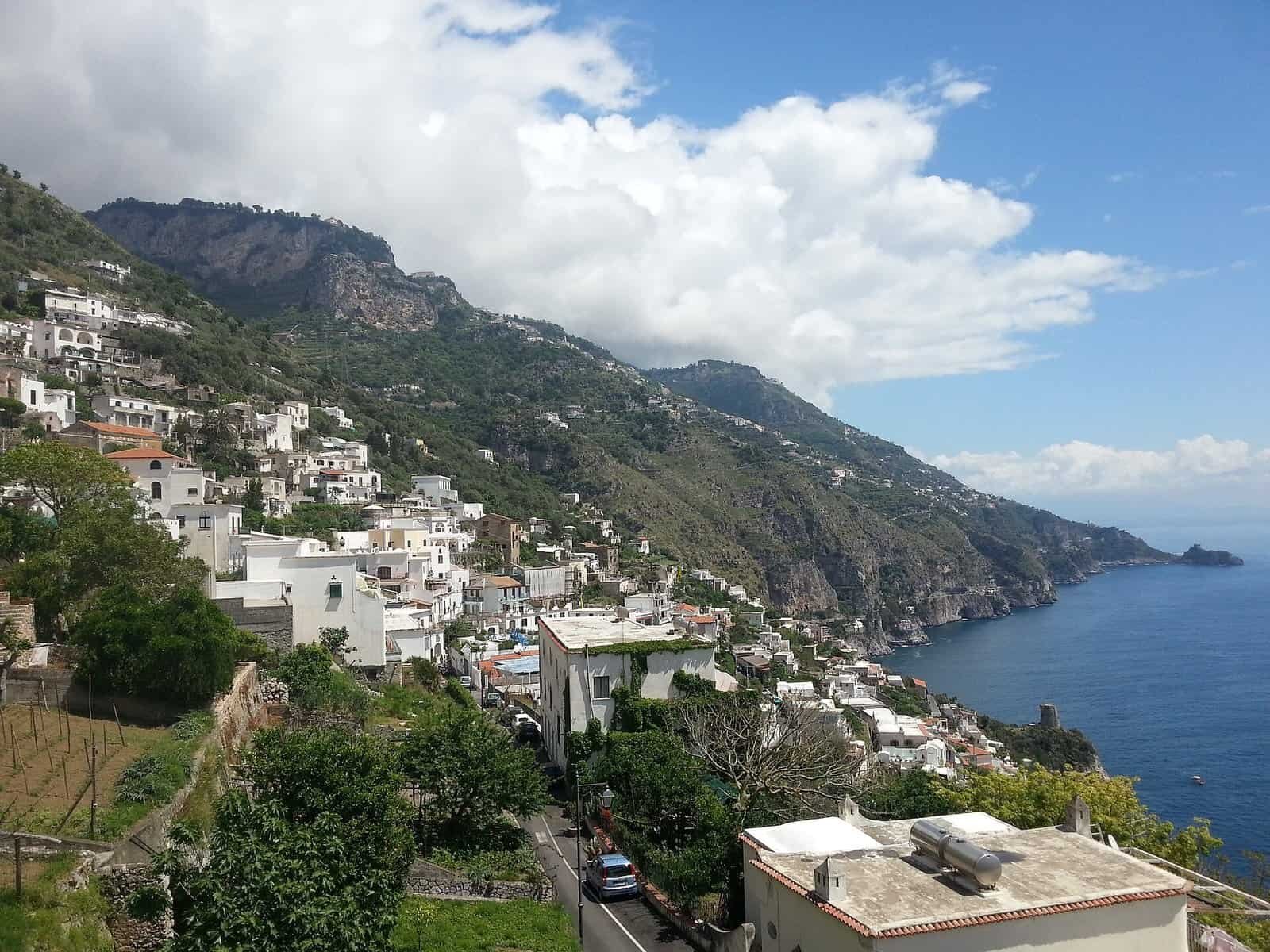
This is where the country gets more interesting and considerably cheaper. Naples is the most alive city in Italy and the most misunderstood — the archaeological museum holds everything good that was dug out of Pompeii, and the pizza is a protected craft rather than a dish. Use it as the base for Pompeii, Herculaneum, Vesuvius and the Amalfi Coast, all of which are day trips.
Puglia, the heel, is the best-value week in Italy right now: whitewashed hill towns, a baroque city at Lecce that has been called the Florence of the south with more justification than that phrase usually carries, an olive-oil landscape, and two coasts. It also holds Alberobello, where an entire district is built from dry-stone conical houses — we have written about that town and its two very different halves in detail.
Sicily is a country pretending to be an island: Greek temples at Agrigento and Segesta better preserved than most in Greece, Arab-Norman churches in Palermo, Baroque towns in the south-east, and Etna, which is both Europe’s most active volcano and a serious wine region. Allow ten days and hire a car. Piedmont in the north-west gives you Turin, truffles at Alba, and the Barolo hills. And Emilia-Romagna — Bologna, Parma, Modena — is simply where Italians go to eat.
The mountains just had their Olympic year
The Milano Cortina Winter Olympics ran from 6 to 22 February 2026, spread across more than 22,000 square kilometres of northern Italy. What makes it unusually relevant to a traveller is how it was built: 11 of the 13 competition venues were existing or temporary, so the legacy is not a set of empty stadiums but upgraded access to places that were already worth going to.

Cortina d’Ampezzo, which also hosted the 1956 Games, took the women’s alpine events plus bobsleigh, skeleton and luge, with curling staged in the restored 1956 Olympic Ice Stadium. Bormio, a medieval spa town below the Stelvio, held the men’s alpine racing and ski mountaineering’s Olympic debut. Livigno took freestyle and snowboard. All three are open, all three are better connected than they were two years ago, and none of them is only a winter destination — the Dolomites in September, with the rifugi still open and the crowds gone, are one of the great walking landscapes in Europe. If skiing is the point, our ski holidays section covers the wider picture.
Traveltalk picks three
Three places to sleep. Le Sirenuse in Positano, a family house turned hotel in 1951 and still run by the same family — the terrace is the Amalfi Coast’s most photographed for a reason. Borgo Egnazia in Puglia, built from scratch to look like an Apulian village and doing more for the region’s reputation than any campaign. And a room on the Grand Canal in Venice — the specific hotel matters far less than the water outside the window, and this is the one Italian splurge that repays itself hour by hour.
Three tables. Osteria Francescana in Modena, Massimo Bottura’s three-star and the restaurant that changed how the world reads Italian cooking. Da Vittorio outside Bergamo, three stars and the most generous cooking in the country. And, deliberately at the other end, Trattoria da Enzo al 29 in Rome’s Trastevere — no stars, a queue, and the carbonara against which the others are measured.
Three things to do. Stand in the Pantheon during rain and watch it fall through the oculus onto the drain built for it nineteen centuries ago. Take the early vaporetto to Torcello, where Venice began, and find eleventh-century mosaics with nobody else in the building. And drive the Great Dolomite Road from Bolzano over the Pordoi pass in late September, when the larches turn and the passes are empty.
Eating in Italy: the rule is regional, not national
The Michelin Guide Italy 2026 lists 394 starred restaurants — 15 with three stars, 38 with two and 341 with one — with the newest three-star going to La Rei Natura by Michelangelo Mammoliti in Piedmont. It is a serious haul. It is also, again, not the number that will change your holiday.
There is no such thing as Italian food; there are twenty regional cuisines that barely acknowledge each other. Ordering carbonara in Bologna, or asking for spaghetti bolognese anywhere in Italy, marks you instantly — Bologna’s dish is tagliatelle al ragù, and the shape is not a detail. Eat what the region grows: rice and butter in the north, pork and pecorino in Rome, tomato and buffalo mozzarella around Naples, fish and citrus in Sicily, olive oil and orecchiette in Puglia. The menu that offers all of it at once is the menu to walk past.
Three practicalities. The coperto — a small per-person cover charge — is normal and legal, not a scam. Lunch is served roughly 12.30–14.30 and dinner from 19.30 in the north, later as you go south, and a kitchen that serves continuously all afternoon is a kitchen that serves tourists. And a proper espresso is drunk standing at the bar in about ninety seconds; sitting down at a table can triple the price, which is not a trick but a different product. If eating is why you travel, our food and wine section goes deeper.

The wine: the most varied vineyard in the world
Italy trades places with France year after year as the world’s largest wine producer by volume, and it grows more distinct native grape varieties than any other country — several hundred in commercial use, against a few dozen that dominate most wine nations. That is the whole character of Italian wine: not one style done at scale, but an enormous number of local answers to local ground.
Piedmont is the aristocrat. Nebbiolo makes Barolo and Barbaresco in the Langhe hills — pale, tannic, extremely long-lived, and best visited in October when the fog the grape is named after actually sits in the valleys and the white truffle market opens at Alba. Tuscany gives you Sangiovese: Chianti Classico, and Brunello di Montalcino, which by law spends years in wood before release. Veneto makes Amarone, from grapes dried on racks for months before pressing — a technique older than the region’s name. Franciacorta in Lombardy is Italy’s serious traditional-method sparkling wine, and quietly better value than its French equivalent.
And then Etna, which is where Italian wine is currently most interesting. Nerello Mascalese grown on black volcanic terraces at up to a thousand metres, on ungrafted old vines that phylloxera never reached, producing reds closer to Burgundy than to anything else in Sicily. Twenty years ago the growers there were selling grapes by the tonne. It is now the address every Italian winemaker wants. Region-by-region guides are coming.
When to go
- April–mid June. The best window for the cities and the countryside both. Book the timed entries early — this is peak demand for them.
- July. Hot, busy, and the Venice fee is running. Workable on the coast and in the mountains; hard in Rome and Florence.
- August. The month to understand rather than fight. Italians take their own holidays, and around Ferragosto on the 15th, city restaurants and family-run shops simply close. Go to the Dolomites or the sea, not to a museum.
- September–October. Our pick, comfortably. The sea is still warm into late September, the harvest is on in the wine regions, the truffle season opens in Piedmont, and the Dolomites are at their best for walking.
- November–March. Rome, Florence, Naples and Venice at a fraction of the price and the crowd, with short days and some rain as the trade. Skiing from December. Venice’s acqua alta peaks in November and December — raised walkways handle it, but check before booking a ground-floor room.
Getting around
The train is the answer for the spine of the country. Rome to Milan takes about two hours 45 minutes over 477 km, and two operators compete on the route — state-owned Trenitalia’s Frecciarossa and the private Italo — which is unusual in Europe and keeps fares honest. Rome–Florence is around an hour and a half; Florence–Venice about two. Book ahead for the cheap fares, and note that a ticket bought on the day at the station can cost three times the advance price.
Hire a car for Tuscany, Umbria, Puglia, Sicily and the Dolomites, and for nothing else. The Amalfi Coast road in summer is a genuinely poor driving experience and the ferries along that coast are quicker, cheaper and better looking. Remember the ZTL cameras. And in the deep south and on the islands, allow considerably more time than the distance suggests — the roads are mountain roads, whatever the mapping app claims.
Where we take Italy from here
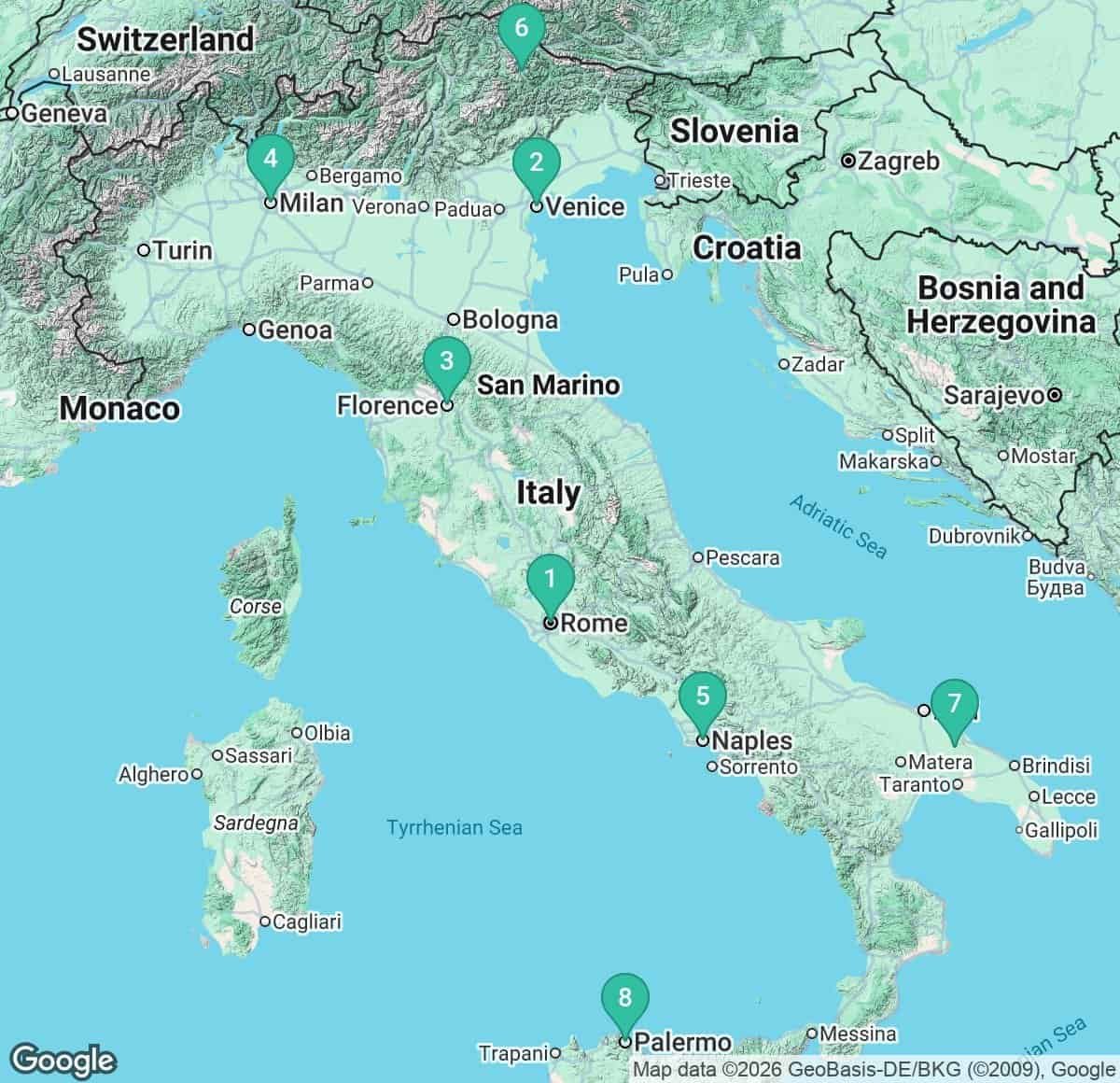
This page is the spine. The regional guides hang off it, in this order: Rome, Tuscany and Florence, Venice and the Veneto, Naples, Pompeii and the Amalfi Coast, Puglia, Sicily, Piedmont and the Langhe, and the Dolomites. Each one gets what this page got: named places, current numbers, and a straight answer about what is worth your week and what is not.
Italy sits inside a wider set of guides. Europe is the parent page, with Spain and Germany alongside this one. If you travel by interest rather than by map, start with city breaks, art and culture, luxury travel or beach holidays. And if you would rather watch than read, TravelTalk Lens holds our film library, with Italy well represented.