
From the traveltalk.dk family – started in Denmark in 2018
Read in: Dansk (original) · Deutsch · Français · Español · Italiano
Cyprus lies closer to Beirut than to Athens
For most Danes, Cyprus is a beach island with a long season and roughly four hours’ flying time from Copenhagen. That is also true. But the island lies well over 200 kilometres from the Lebanese coast and nearly 900 from Athens, and that geography has seeped into everything: into the cooking, the language and who has built what over the centuries. Cyprus is the easternmost member of the EU, and it is the only large island in the Mediterranean that remains divided.
At 9,251 square kilometres, Cyprus is the third-largest island in the Mediterranean after Sicily and Sardinia. Around 1.3 million people live on the island, just under a million in the Republic of Cyprus to the south and the rest in the Turkish-controlled north. The capital is called Nicosia on both sides of the line. Greek, Turkish and English are spoken, and the last has its own explanation: the island was a British colony until 1960, and Britain still holds two sovereign base areas, Akrotiri and Dhekelia, which are formally British territory. That is also why people drive on the left. On our overview of the Middle East, Cyprus appears as the only EU country.
Nicosia is Europe’s last divided capital
The Green Line has divided the city since 1974 and is patrolled by the UN. What is unusual is how undramatic it looks in everyday life. On Ledra Street, Nicosia’s busiest pedestrian thoroughfare, you walk past clothes shops and coffee bars and then come upon a border crossing right in the middle of it all. It opened in 2008, and the crossing takes five minutes with your passport in hand. On the other side lies the same city, with different signs, a different currency and a different language.
Inside the buffer zone stands Nicosia International Airport, closed since 1974, with an abandoned Cyprus Airways aircraft on the apron. No one has touched it in half a century. It is the kind of place that does more for a traveller than a museum would, and it is a large part of the reason Cyprus is worth more than a beach week.

You can ski in the morning and reach the sea for lunch
The Troodos Mountains rise to 1,952 metres at the summit of Chionistra, also known as Olympus. The Cyprus Ski Club operates four lifts up there, and the season typically runs from early January to the end of March. The runs are called Zeus and Aphrodite. It is about an hour’s drive down to Limassol and the coast.
That makes February and March the island’s most underrated months. The mountains have snow, the almond trees blossom in the lowlands, and the big holiday crowds have not yet arrived. The sea is too cold for swimming, but everything else is open.
Three sites on the UNESCO World Heritage List
They are close enough to one another that you can visit all three in a week. Paphos was added to the list in 1980 and covers the entire archaeological city: the Sanctuary of Aphrodite, the Tombs of the Kings and the Roman floor mosaics, which are among the best preserved in the Mediterranean. The Painted Churches of Troodos followed in 1985: ten small mountain churches with Byzantine wall paintings, and this building form exists nowhere else. Choirokoitia was added in 1998 and is a Neolithic settlement from the 7th millennium BC, one of the most important in Europe.

Outside the list lies Kourion, perched on a cliff above the sea west of Limassol, with a Greco-Roman theatre that is still used for concerts. And by the salt lake outside Larnaca lies Hala Sultan Tekke, one of Islam’s most significant shrines and at the same time the place where the flamingos gather in winter.

Halloumi may only be made in Cyprus
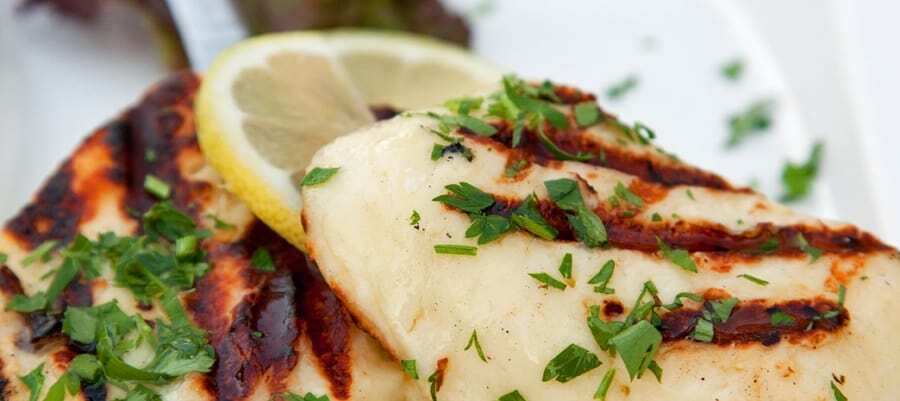
Since April 2021, halloumi has held a Protected Designation of Origin in the EU. The cheese may only bear the name if it is produced in Cyprus according to the Cypriot recipe with goat’s and sheep’s milk. On the island it is grilled and served warm, often alongside watermelon, and it is not the same product as the firm block most Danes know from the chilled shelf.
The wine is called Commandaria and also has its own Protected Designation of Origin. It comes from fourteen villages on the southern slopes of Troodos and is made from sun-dried grapes of the local varieties xynisteri and mavro. It is sweet, dark and aged, and it is easier to find on the island than at home.
When it is worth going
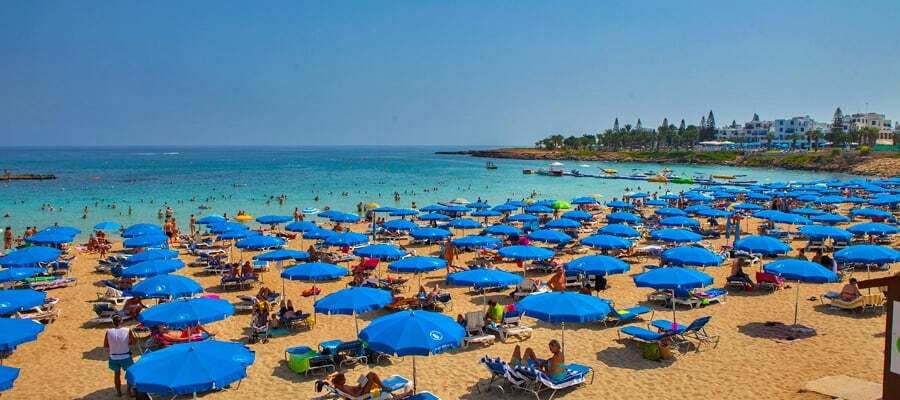
Cyprus has one of the longest bathing seasons in the Mediterranean. The sea sits around 18-19 degrees in April and is still around 24 degrees in November. The interior, on the other hand, is harsh in summer. Nicosia lies far from the coast, and the thermometer regularly passes 40 degrees in July and August, which is worth knowing if your plans involve more than a beach.
May, June, September and October are the months that work for both. Ten good reasons to holiday in Cyprus is for most people chiefly about the climate, while our introduction to the island covers the practicalities: where you arrive, and what you can fit into a week. Cyprus also counts among the most remarkable islands, alongside Malta, Madeira and the Azores.
See a map of Cyprus
Practical travel information for Cyprus
🛂 Entry, passports and Schengen
- Cyprus is in the EU, but not in Schengen. The country joined the EU in 2004, and as of August 2026 it still stands outside the Schengen Area. The European Commission adopted a positive assessment of Cyprus’s readiness in July 2026, and the Council is expected to vote in September 2026.
- The consequence right now: take your passport with you, even though the journey is within the EU. A Schengen visa does not cover Cyprus.
- Northern Cyprus: the crossings from south to north are open, and crossing requires a passport. Fly into Larnaca or Paphos — direct entry to the north is not recognised by the Republic.
💰 Currency and money
- Currency: the euro in the Republic of Cyprus. In the north, Turkish lira is used, but euros are accepted in many places.
- Cards: widely accepted in the south. Carry cash for the mountain villages and for the north.
- Tipping: 5-10 per cent is standard, and a service charge is often already added to the bill.
🚗 Transport, timing and season
- Flight time from Denmark: about 4 hours to Larnaca.
- ⚠️ Left-hand traffic. A British legacy, and it catches Danish drivers out every year. A rental car is otherwise the best way to get around.
- Time zone: one hour ahead of Danish time.
- Best time to visit: May-June and September-October. January-March for the mountains, July-August only if you stick to the coast.
- Languages: Greek and Turkish. English is spoken almost everywhere.
- Electricity: British three-pin plugs, type G. Remember an adapter.