
From the traveltalk.dk family – started in Denmark in 2018
Read in: Dansk (original)
Malaysia
Malaysia is a country of many facets, geographically, culturally and religiously, not to mention its travel experiences.
Its location is unusual, with one part of the country on Borneo and the rest on the mainland. Historically, the Malaysia we know today only came into being in 1965 as a federation made up of several former British protectorates and states. Singapore was in fact one of them, but it seceded as early as 1967.
Religion is important in the region, but also fairly liberal. The main religion is Islam, but the country has freedom of religion and quite a number of Buddhists, Hindus, Christians and Taoists. Taoism is more a Chinese philosophy and life principle, known through the yin and yang symbols. It is a gift to the country that it has managed well to coexist with the many ways of understanding the world and the heavens.
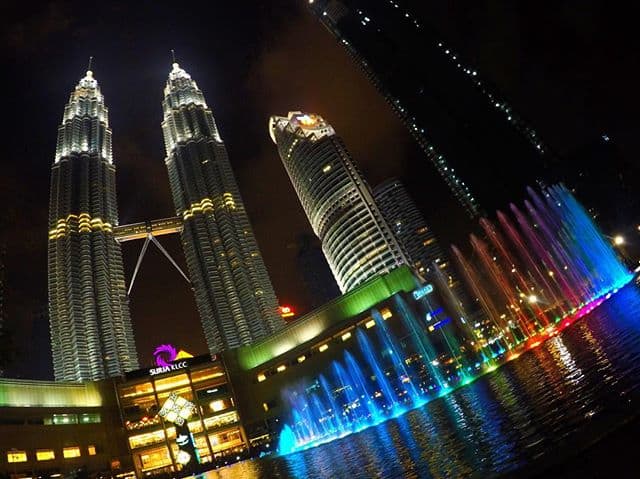
In the capital, Kuala Lumpur, the Petronas Towers literally soar high into the sky. They are two identical skyscrapers built side by side. They were once the tallest buildings in the world. They make up a pair of twin skyscrapers built next to each other.
In brief:
Malaysia is a country in Southeast Asia, divided into a western part on the Malay Peninsula and an eastern part on the island of Borneo. On the mainland, Malaysia borders Thailand to the north and the city-state of Singapore to the south.
Capital: Kuala Lumpur
Currency: Malaysian ringgit
Population: 30.33 million (2015)
Prime Minister: Najib Razak
Official language: Malay
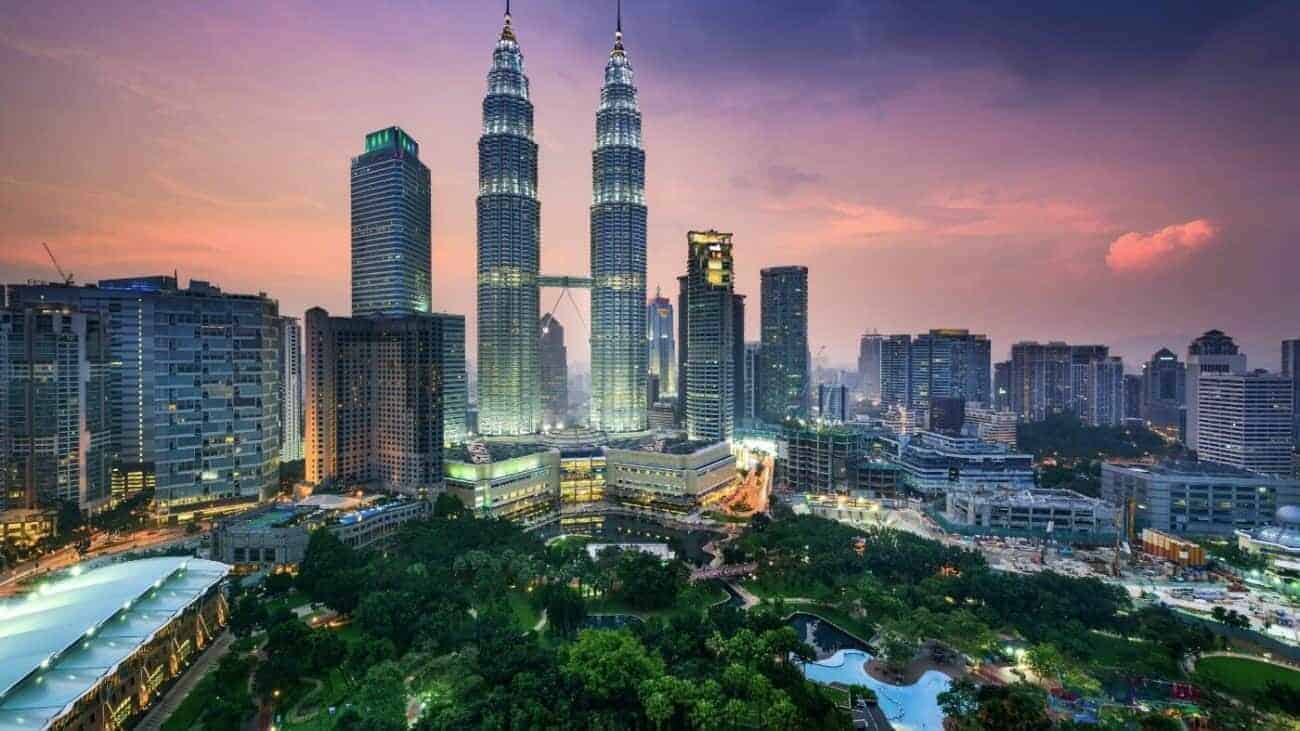
When to travel to Malaysia
Malaysia has two climates that do not coincide. The peninsula and Borneo do not follow the same season, which is why there is no single answer for the whole country.
The west coast of the peninsula, with islands such as Langkawi and the beach towns along the Andaman Sea, is driest and clearest from December to February. From around May to September, the south-west monsoon blows over the coast, and the sea becomes rough with rain and high waves, especially in those months.
The east coast of the peninsula, off which lie the Perhentian and Tioman islands, is the opposite. Here it is the north-east monsoon that brings the rain, from around November to February. Between March and October the water is calmer, and that is the time most east coast destinations suit best.
Borneo has a more even climate. It is hot and humid all year round, and it often rains in the afternoon in a short, heavy downpour. The rainy season is not fixed, but November to February is the wettest in most parts of the island. If you want to go hiking in the rainforest in Sabah or Sarawak, the drier half of the year from March to October is preferable, partly because the trails are then easier to walk.
Kuala Lumpur can be visited for most of the year. The heat here is constant, and it is above all the rain that determines the day’s plans.
Travelling in Asia
- An introduction to travel across all of Asia
- 10 incredible places in Japan
- Wonderfully exotic Vietnam
- The Philippines for the top 10 beaches in the world
- Thailand and its many lovely islands
- Asia’s 10 smallest countries
How to get there
Most visitors fly to Kuala Lumpur, where the international airport KLIA lies some distance outside the city. There are no direct flights from Europe, so the journey requires at least one stop. The typical route is a connection at a European or Middle Eastern hub and then onward to Malaysia, and the total travel time is around 13 to 14 hours when connections are good.
Kuala Lumpur is also the gateway to Borneo by air, and there are several domestic connections from the capital to cities on the island. Kota Kinabalu in Sabah and Kuching in Sarawak are the largest airports there. If you want to reach the beach islands on the east coast, many instead fly to Kuala Lumpur and then take a domestic flight or a shorter hop to the airports closest to the islands.
Airlines change over time, and prices vary a great deal by season. It is a good idea to check the specific routes and transit times before booking, especially if you are continuing on a domestic flight the same day, where a delay can cause problems.
From Singapore you can also travel overland to the peninsula. It is a journey that can be done by bus or train, but border controls can take time, and it is worth allowing extra waiting time in the high season.
What it costs
The price level in Malaysia is low compared with Europe. A meal at a simple street kitchen or a hawker centre typically costs a few ringgit, while a restaurant with table service and several courses is more expensive, but still well below European prices. A cold beer or a bottle of water in a shop also costs very little.
Transport in the cities is cheap. A taxi ride over a short distance in Kuala Lumpur usually costs under ten ringgit, and a metro journey costs even less. Flights between the peninsula and Borneo can vary a lot in price, and they are often more expensive than train journeys on the peninsula.
Accommodation varies the most. A simple guesthouse or budget chain may cost only a few hundred kroner a night, while a large international hotel in Kuala Lumpur or a resort on Borneo can cost several thousand kroner per night.
It is worth checking current prices before you travel, as exchange rates and price levels change. A good tip is to keep a small margin in the budget for airport expenses, ferries and trips to natural areas, which often cost more than expected.
Food and drink
Malaysian food is a blend of Malay, Chinese and Indian cuisine, and it is one of the biggest reasons to go there. The best-known dish is nasi lemak, rice cooked in coconut milk and served with sambal, cucumber, roasted peanuts and typically a piece of chicken or a fish. It is often eaten for breakfast, but is available all day.
Roti canai is a flat, crispy bread dish that comes from Indian cuisine and is cooked in front of the guest. It is often served with dhal or curry. Laksa is a spicy noodle soup, and there are several versions, including ones with coconut and tamarind, so the flavour varies a great deal from place to place.
Street food stalls and hawker centres are where you should eat the most. Here you will find satay with peanut sauce, char kway teow, fried noodles and many kinds of fruit and sweet drinks. Choose places where there are plenty of locals and the food is cooked fresh.
Also try teh tarik, a sweet milk tea that is poured from a height so that it froths. And tropical fruits such as durian and mangosteen are worth tasting, although durian has a strong smell and not everyone likes it.
Where to stay
In Kuala Lumpur you will find everything from large international hotels in the central districts around Bukit Bintang and KLCC to small boutique hotels and guesthouses in older neighbourhoods such as Chinatown and Brickfields. The central areas are convenient because the metro is close by, but they can be noisy in the evening. Prices range widely, from budget to luxury, and the most expensive hotels are found near the skyscrapers.
On Borneo the choice is more spread out. In Kota Kinabalu most people stay in the town or near the beaches by the harbour, and there are both lodge-style guesthouses and larger resorts. Out in nature there are often nature lodges or small bungalow accommodation close to the rainforest and mountains, and here it is an advantage to book well in advance.
On the east coast islands such as Perhentian and Tioman there are mainly small beach huts, guesthouses and a few mid-sized resorts. The standard here varies a great deal, and it is worth reading recent reviews before choosing a place. Many places have limited electricity or water at certain times, especially outside the high season.
You should also keep in mind that many hotels in the Muslim parts of the country do not serve alcohol, and that some places have dress rules outside the beach areas.
Practical travel information for Malaysia
🛂 Visas and entry
- Visa: Danish citizens can enter without a visa for up to 90 days.
- MDAC: all travellers must complete the free Malaysia Digital Arrival Card no later than 3 days before arrival on the official portal (imigresen-online.imi.gov.my).
- Passport: valid for at least 6 months.
💰 Currency and money
- Currency: Malaysian ringgit (MYR).
- Cards vs. cash: cards are accepted in cities, hotels and shopping centres; carry cash for street food stalls, markets and small towns.
- Cash machines: widespread.
- Tipping: not a fixed custom — appreciated, but not expected.
🚗 Transport, time and health
- Flight time from Denmark: approx. 13–14 hours with one stop.
- Getting around: cheap domestic flights between the peninsula and Borneo; good trains and buses on the peninsula.
- Best time to travel: the monsoon changes — the west coast is best December–February, the east coast and Borneo March–October.
- Time zone: +7 hours compared with Danish winter time.
- Language: Malay (Bahasa); English is widely spoken.
- Health: no compulsory vaccinations; hepatitis A and mosquito protection (dengue) are recommended; malaria in the interior of Borneo. Drink bottled water.
- Safety: generally safe — follow the Danish Ministry of Foreign Affairs’ travel advice.
Transport within the country
On the peninsula it is easiest to travel by train and bus between the larger cities. The trains are comfortable and work well on the main routes along the west coast, while the bus network covers the rest. In Kuala Lumpur there is a metro and several light rail lines, and they are the quickest way to get around the dense city centre when traffic on the roads is at a standstill.
Taxis are available everywhere, but you should use the meter or agree the price before getting in. Grab, an app for booking cars and motorbikes, is widespread in the cities and often makes it easier to know what the journey will cost and to follow it along the way. It is also the most common way to book transport when you cannot speak Malay.
On Borneo distances are longer, and the roads are not always good. Many people choose to fly between towns rather than drive. For the deep forests and high mountains of Sabah, including the area around Kinabalu, a local driver with a four-wheel-drive vehicle is often required, and it is a good idea to arrange this through a reliable contact in advance.
If you want to get out to the islands, the ferry is the usual solution. It is cheap, but the sea can make the crossing unpleasant during the monsoon months, and sailings are sometimes cancelled because of the weather.
More about Malaysia
Nearby
Bangladesh
Bangladesh is a country in South Asia. Before 1971 it was known as East Pakistan. Its…
Bhutan
Bhutan has historically been very isolated, yet remarkably forward-thinking when it comes to protecting its land.…
Cambodia
Cambodia borders Thailand to the west and north-west, Laos to the north, Vietnam to the east…


