
From the traveltalk.dk family – started in Denmark in 2018
Read in: Dansk (original) · Deutsch
The Maldives and its white sand beaches beckon
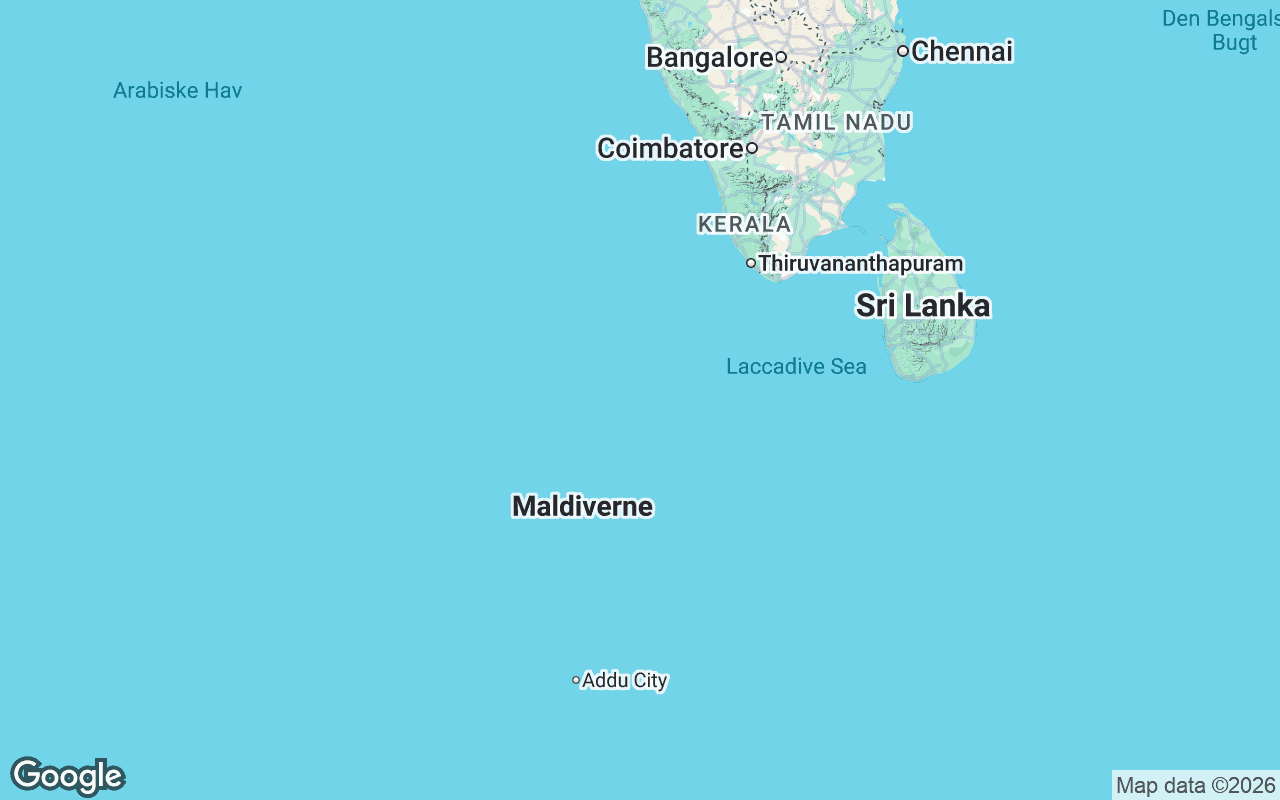
At first glance on a world map (see below), the Maldives is an easy country to overlook — it is one of Asia’s 10 smallest countries. Some 750 kilometres south-west of Sri Lanka lies this small, beautiful archipelago of no fewer than 1,192 islands in the Indian Ocean. 187 of them are inhabited by local Maldivians, who are world-renowned for their hospitality towards the tourists who visit them. There is a multitude of experiences whichever island you choose, but due to global warming and rising sea levels, the archipelago’s extraordinary natural beauty may be submerged before the year 2100. There is no time to lose — get going!
When is the best time to go to the Maldives?
The Maldives has two distinct seasons, and the difference is noticeable even for someone who has never seen a monsoon before. The dry season falls essentially between November and April. The wind holds steady from the north-east, the sea becomes calm, and underwater visibility is often at its best of the year. This is when most people travel there, and also when resort prices are often at their highest.
The wet season from May to October brings strong south-westerly winds, sudden rain showers and choppy water on some routes. The sun still often breaks through between the clouds, and prices are lower. It is also when manta rays and whale sharks gather in the current-rich passages, so divers with patience often have powerful experiences in exactly this period.
If you want sunshine and clear water, November to early April is the safe choice. If you want quiet and peaceful night dives, and don’t mind a few rainy afternoons, the wet months can be a wise choice. Whenever you travel, you should expect the weather to change quickly, and it is good to have a plan B for the days when the seaplanes don’t fly.
Food, drink and local cuisine
The local cuisine of the Maldives is built on fish, coconut, rice and spices. Tuna is the foundation of many dishes, and the fish soup garudhiya, made from tuna, onion and chilli, is one of the most typical. The bread roshi, a thin flat type, is often served for breakfast with fish topping. If you are in a local village, it is a good way to taste the real cuisine.
Alcohol is not permitted on the inhabited local islands, and this also applies to tourists staying in guesthouses. On resorts it is allowed, and most have a bar and restaurant with drinks, though at prices higher than at home. It is good practice to respect the local rules, and to drink only what is permitted without leaving the resort area in an intoxicated state.
At resorts you typically get food from a wide range of cuisines, and the food is usually tailored to international guests. On the local islands the choice is simpler, but also more authentic. Feel free to ask your host what is on the menu and what is available that day, as supplies to the islands can be limited.
How to behave – rules, dress and health
The Maldives is a Muslim country, and this is felt in everyday life, especially outside resorts. On the inhabited local islands, both men and women are expected to dress modestly. Swimwear belongs on the beach or by the pool at the resort, and should not be worn in the village. Many resorts have a special beach for sunbathing and swimming, so that locals are not disturbed.
As mentioned, alcohol is prohibited on the local islands, and it is not permitted to bring alcohol onto them either. This also applies to importing it into the country, so customs rules should be checked before you travel. Also be aware that public displays of affection and being visibly drunk are frowned upon, and locals may react strongly to it.
You should check the current vaccination requirements and recommendations with your doctor or a travel health clinic before departure, as they can change. It is also a good idea to have travel insurance that covers medical treatment and evacuation, as medical facilities on the small islands are limited, and serious cases often have to be moved to Malé or onward abroad. Watch out for the sun and the hot climate, and drink plenty of water.
📄 Quick facts about the Maldives
- Location: Indian Ocean, approx. 750 km south-west of Sri Lanka — 26 natural atolls, 1,192 islands, of which 187 are inhabited
- Capital: Malé, on Kaafu Atoll
- Language: Dhivehi — English is spoken wherever there are tourists
- Currency: Maldivian rufiyaa (MVR) — US dollars are accepted at virtually all resorts
- Highest point: approx. 2.4 m above sea level — the world’s flattest country
- Best season: November–April, dry and with the clearest underwater visibility. May–October is the wet monsoon, but it is also when manta rays and whale sharks gather
- Recommended trip length: 7–10 days
- ✈️ Departing from: Copenhagen Airport (CPH) — no direct flights. The route typically goes via Istanbul, Dubai, Doha or Frankfurt, and the journey takes 12–15 hours including connections
💡 Traveltalk tip
Choose the atoll before you choose the hotel. One island is one hotel, and once you have sailed there, there is no other beach, other restaurant or other bar. The distance from Malé decides the rest: a boat taking twenty minutes costs little, a seaplane costs many thousands of kroner and does not fly after dark — so a late-arriving flight can mean an extra night in the capital before the holiday even begins.
Insider tip: the local islands are the cheapest option the Maldives has. Since 2009, guesthouses have been allowed to host tourists on the inhabited islands, and a bed there costs a fraction of a water villa. In return, it is a Muslim island community with the rules that come with it — swimwear belongs on the designated “bikini beach”, not in the village.
How to get around between the islands
The Maldives consists of many small islands, and how you get from one to another determines much of your trip. Most journeys start in Malé, the capital, where international flights land. From there you continue with one of the three forms of transport in use: boat, ferry or seaplane.
For the nearest islands, especially those within a short distance of Malé, people often use a fast speedboat. The crossing can be brief, but out on the open sea it can be bumpy, so it is a good idea to keep your luggage packed in a waterproof bag. Larger resorts may have their own boat transfers, while the smaller local islands typically have a local ferry service that runs to a fixed timetable.
The longer journeys to the outermost atolls and the most exclusive resorts are often made by seaplane. The flight is an experience in itself, but seaplanes do not fly after dark, and they depend on the weather. If you have a late flight from Europe, it may mean an overnight stay in Malé before you can continue. When you book, ask your resort how the transfer works and what happens if the weather changes your plans.
Staying on the islands – from resorts to local islands
Most foreign visitors stay at resorts located on their own islands. Here there is one hotel per island, and everything from the restaurant to the bar and the beach lies within the same small area. The type of resort varies a great deal, from simple beach bungalows to overwater villas standing on stilts above the lagoon. An overwater villa sits at the upper end of what you can pay for a hotel stay, and its price should be checked carefully, as food, drinks and transfers are often not included in the same way everywhere.
Another option is guesthouses on the inhabited local islands. They are far cheaper than resorts, and you gain a much more genuine insight into everyday life in the country. There is less comfort, simple rooms and shared facilities, but also closer contact with the locals. It requires some adjustment, as this is a Muslim island community with its own rules.
Prices vary considerably between seasons and islands, and there is no fixed price level you can count on. As a rough guide, guesthouses on local islands are the cheapest accommodation, mid-range resorts cost noticeably more, and the exclusive overwater villas are the most expensive. Always check what is included in the price before you book.
🤝 Travel partner — the spot is open. Here we recommend travel partners: who can deliver the trip, or simply accommodation or transport? Do you arrange trips to the Maldives? The spot could be yours — write to us at hello@leisuretalk.net.

The Maldives has a population of just over half a million people, spread across almost 200 inhabited islands. The many Maldivian islands are divided into 20 administrative atolls. Kaafu Atoll contains Malé Island, home to the sunny capital, Malé. In the capital you can see the historic Friday Mosque, built in 1658 and made of coral. Malé is also the town where most people end up spending the night if their flight lands late and the seaplane does not leave until the next morning — our travel tips for the Maldives will guide you through the planning.

Unforgettable diving adventures in the Maldivian coral reefs
A trip to the Maldives is an obvious choice for true lovers of life’s pleasures. Stroll along the soft sandy beaches, or join a morning yoga session and watch the sunrise while seated in the lotus position. Take on unforgettable diving adventures in the Maldivian coral reefs, either alone or as a group, and see corals and fish in the crystal-clear sea. Treat yourself to a gentle massage in one of the enchanting Maldivian bungalows that stand on stilts above the water, and finish with a warm dip in the balmy water.
There is plenty to take on when you travel to the Maldives. One thing is certain, though — indulgence is guaranteed in this tourist-friendly and welcoming country. It will be a trip you remember for ever.

More articles about the Maldives
More about The Maldives
Nearby
Bangladesh
Bangladesh is a country in South Asia. Before 1971 it was known as East Pakistan. Its…
Bhutan
Bhutan has historically been very isolated, yet remarkably forward-thinking when it comes to protecting its land.…
Cambodia
Cambodia borders Thailand to the west and north-west, Laos to the north, Vietnam to the east…


