
From the traveltalk.dk family – started in Denmark in 2018
Read in: Dansk (original)
Guadeloupe: the small French island group
Guadeloupe, or the Guadeloupe Islands in English, is a small archipelago under French rule that is not as far away as you might think: in a straight line it is only 7,300 km, and less than 500 km from Florida. It is more than one island, though the others are fairly small, usually less than a few kilometres in length.
These are the five islands that best describe Guadeloupe as a whole: Basse-Terre, Grande-Terre, La Désirade, Les Saintes and Marie-Galante. Five islands with rich biodiversity and great natural beauty. Le papillon, the butterfly.
The two largest islands form what is known as “le papillon”, or the butterfly. To the west lies Basse-Terre, a volcanic mountainous island with the La Soufrière volcano, covered in dense, lush rainforest and tropical vegetation, and home to its own Guadeloupe National Park.
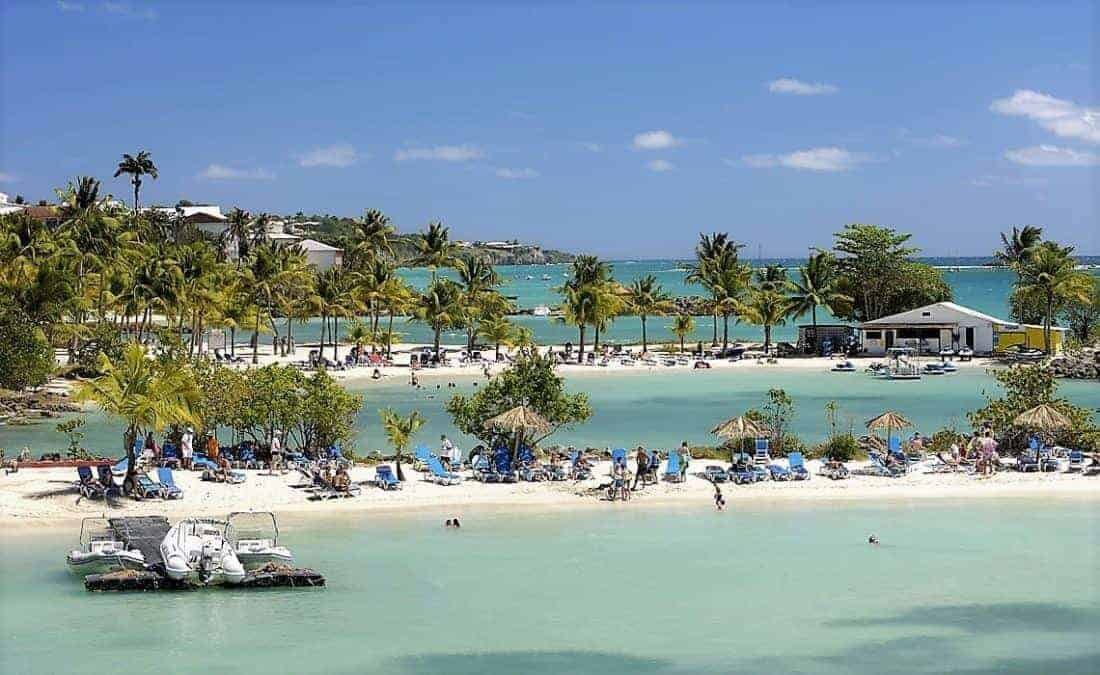
To the east lies Grande-Terre, a vast limestone plateau fringed with perfect white beaches and a fashionable tourist resort. To the south is La Désirade, a little private and untouched by the passing of time, where the not-so-fearsome iguana is king. Les Saintes is a petite island with one of the most beautiful bays in the world, and finally Marie-Galante, which again has lovely sandy beaches and a welcoming population, and is well worth a visit.
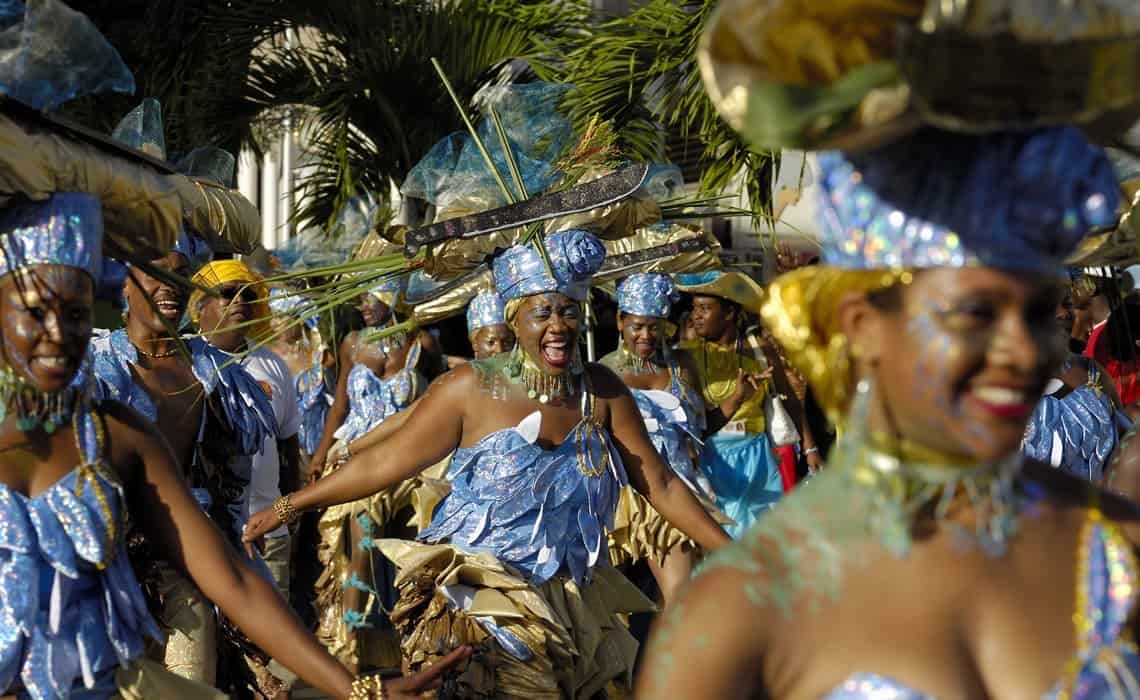
Guadeloupe’s Carnival Guadeloupe is also known for its decorative “Créole Art de Vivre”, which finds expression in a warm and sensual way of life. Try the cuisine, with the most delicious fish and shellfish soups, and join in the celebrations.
Good to know about Guadeloupe
Guadeloupe is a French overseas department in the Caribbean made up of a number of islands with a combined area of 1,628 km². The archipelago has 400,736 inhabitants and belongs to the Lesser Antilles.
Capital: Basse-Terre
Area: 1,628 km²
Population: 405,739 (1 January 2013)
Continent: North America
Travel to Guadeloupe
Safety and health
The sun is strong all year round, and you can burn quickly even when it is overcast. Use sunscreen with a high protection factor and drink plenty of water, especially if you walk a lot in the mountains or spend the day on the beach. The tropical heat and humidity also mean you tire quickly.
Mosquitoes are a real nuisance, and in the wet season there can be many of them. Dengue and other mosquito-borne diseases occur in the area, so use an effective insect repellent, cover up in the evening and consider long sleeves. Check the current health advice before you travel, and speak to your doctor about any vaccinations you may need.
Hurricanes are the most important weather phenomenon to watch out for in the summer and autumn months. Keep an eye on the forecasts, and stay informed through local authorities if you are on the islands during that period. Also take care when swimming in the sea, where there can be strong currents, especially on exposed beaches, and follow local signs and instructions.
Practicalities and costs
The currency is the euro, as Guadeloupe is a French department. Many places accept cards, but it is wise to carry some cash for smaller shops, stalls and local markets. The language is French, and in rural areas the Creole language is also spoken, as many locals use it in everyday life. It is a good idea to know a few French courtesy phrases, as they are always well received.
For visitors from Denmark, the same entry rules apply as for other EU citizens when travelling to a French department. Your passport must be valid for the period you plan to stay, and it is worth checking the current requirements with the official authorities before departure, as the rules can change.
Prices are higher than in many other Caribbean destinations, particularly for food, transport and hotels in the most visited areas. It is a good idea to have travel insurance that covers illness, repatriation and cancellation, as medical care and hospital treatment can be expensive for tourists. Check what your existing insurance covers before buying new cover.
Where to stay
On Grande-Terre you will find the largest resorts and the most established hotels, especially in the area around Saint-François, where the beach is wide and the hotels often have their own facilities. Prices here are high, but it is a good choice if you want everything in one place and do not want to do a lot of driving.
On Basse-Terre and in the smaller towns there are more intimate boutique hotels and small guesthouses, where the hosts often know the area well and can give good advice on where to eat and what to visit. This is also where you will find many gîtes, which are private homes or small apartments, often with their own kitchen. They are a good option for families and for those who want to stay somewhere for longer.
On the small islands such as La Désirade, Les Saintes and Marie-Galante, the choice is more limited. There are a few hotels and gîtes, and it is an advantage to book early, as the number of rooms is restricted. Prices vary considerably from place to place, so it is worth comparing before you decide.
How to get around
Between the islands, the ferry is the most obvious form of transport. It runs to Les Saintes and Marie-Galante, among other places, and the crossing is a lovely way to see the sea. Do be aware, however, that there may be few ferry departures on days outside the main season, and that the weather can affect when sailings run. Plan your return journey with some margin.
On the larger islands, hiring a car is by far the most flexible option, especially if you want to explore the mountains of Basse-Terre and the many small beaches. The roads are in reasonable condition, but they are often narrow and winding, and journeys can be slow. You will need to get used to driving on the right-hand side, as in France, and to drivers often going fast in towns.
Public buses exist and are cheap, but they do not always run to a fixed timetable, and they do not reach every corner. They are best suited to shorter trips between towns. If you are on a tight budget and have plenty of time, they can be a good solution, but they are not ideal if you need to catch a ferry or flight at a particular time.
How to get there
There are no direct flights from Denmark to Guadeloupe. Most travellers make a European city their first stop and continue from there by air to Pointe-à-Pitre, the largest airport on the islands, on Grande-Terre. This typically involves a change in Paris, and it often makes sense to use the French capital as a hub, as the connections from there to the Caribbean are numerous.
The journey from Denmark typically takes a long day or more, with waiting time at airports along the way. If you allow for connections and changeover time, it’s wise to build in plenty of margin, especially if you’re continuing by ferry or local transport to one of the smaller islands.
Flight routes and timetables change, so they should be checked when you plan your trip. It’s also a good idea to confirm whether your luggage can be checked through, so you don’t have to collect it and check it in again in the middle of a long connection.
When is the best time to travel
Guadeloupe has a tropical climate with temperatures that stay almost constant all year round, and the difference between the seasons lies first and foremost in the amount of rainfall. The dry season falls mostly in winter and early spring, when there is less rain and the air is slightly less humid. These are the months most people choose when travelling there.
The wet season falls in the summer and autumn months. Rain often comes as short, heavy showers in the middle of the day, after which the skies clear again. This doesn’t mean your holiday is ruined, but you should expect some days to be greyer than hoped, especially in the high mountains of Basse-Terre, where the rainforest holds on to the moisture.
The drawback you should take seriously is the hurricane season, which runs from June to November. During those months, powerful storms can hit the islands, and travel plans may be changed at short notice. If you’re considering a trip in September or October, you should therefore follow the weather forecasts closely and have a flexible plan. If you choose to travel during the main season in the winter half of the year, the risk of storms is low.


