
From the traveltalk.dk family – started in Denmark in 2018
Read in: Dansk (original)
Puerto Rico: exotic Caribbean, yet so close to the USA
You can also visit Puerto Rico in 2021, but you need to know how. See more in our article on the reopening of the Caribbean.
Puerto Rico in the Caribbean – not to be confused with the island of the same name off Gran Canaria – gives you the best of two worlds as a destination.
An exotic Caribbean island, close to the USA and close to American lifestyle and form of government.
The country, or more precisely the free state, is the easternmost and smallest of the major Antilles. Puerto Rico consists of the main island, which is slightly larger than Zealand, and a larger number of smaller islands. Puerto Rico is a so-called free state under the United States but with its own government headed by a governor. Puerto Rican residents hold American citizenship but have no influence over political decisions in the United States:
Where to stay
San Juan is the largest city and the natural starting point for most visitors. Here you will find large international hotels along the beach areas, which are typically in the high price bracket, especially in peak season. There are also smaller boutique hotels and apartments, and this is a good choice if you want to be closer to the city’s life.
Old San Juan is the historic district, with narrow colonial-style streets and brightly coloured façades. Here you stay close to the sights and restaurants, but there are fewer spaces and parking can be a serious problem, so check the parking options if you are driving. Hotels here are often small and have more character than the large resorts.
Rincón on the western side of the island is known for its surfing beaches and a more relaxed atmosphere. There are smaller hotels, guesthouses and small restaurants, and the price level is generally lower than in San Juan. It is a good place if you want a quieter holiday, but remember that you are further from the city’s airport and service facilities.
El Yunque is Puerto Rico’s rainforest and a popular excursion destination. Most people do not stay inside the national park itself but in nearby towns, and it is worth planning your visit so that you can arrive early, before the largest crowds appear.
Food and prices
Puerto Rican food is a fusion cuisine with roots in Spanish, African and Taíno Indigenous traditions. The best-known dish is mofongo, mashed green plantains mixed with garlic and often olive oil, typically served with meat, fish or shellfish. There is also lechón, slow-roasted pork, and a range of fried and stewed dishes flavoured with herbs such as recaíto.
Restaurant prices vary a great deal. Simple local places serving fried dishes and a plate of food are cheap compared with the large hotels and the modern restaurants in San Juan, which can be on a par with American price levels. Drinks such as beer and rum are generally cheap in shops but expensive in restaurants and bars, especially in the tourist areas.
Activities such as boat trips, guided rainforest tours and diving trips typically sit at a level similar to other Caribbean destinations. Prices vary greatly by season and operator, so there is no fixed rule of thumb. It pays to get specific quotes before you plan your budget, and to expect that tipping is customary in the service sector.
The landscape of the beautiful Caribbean island
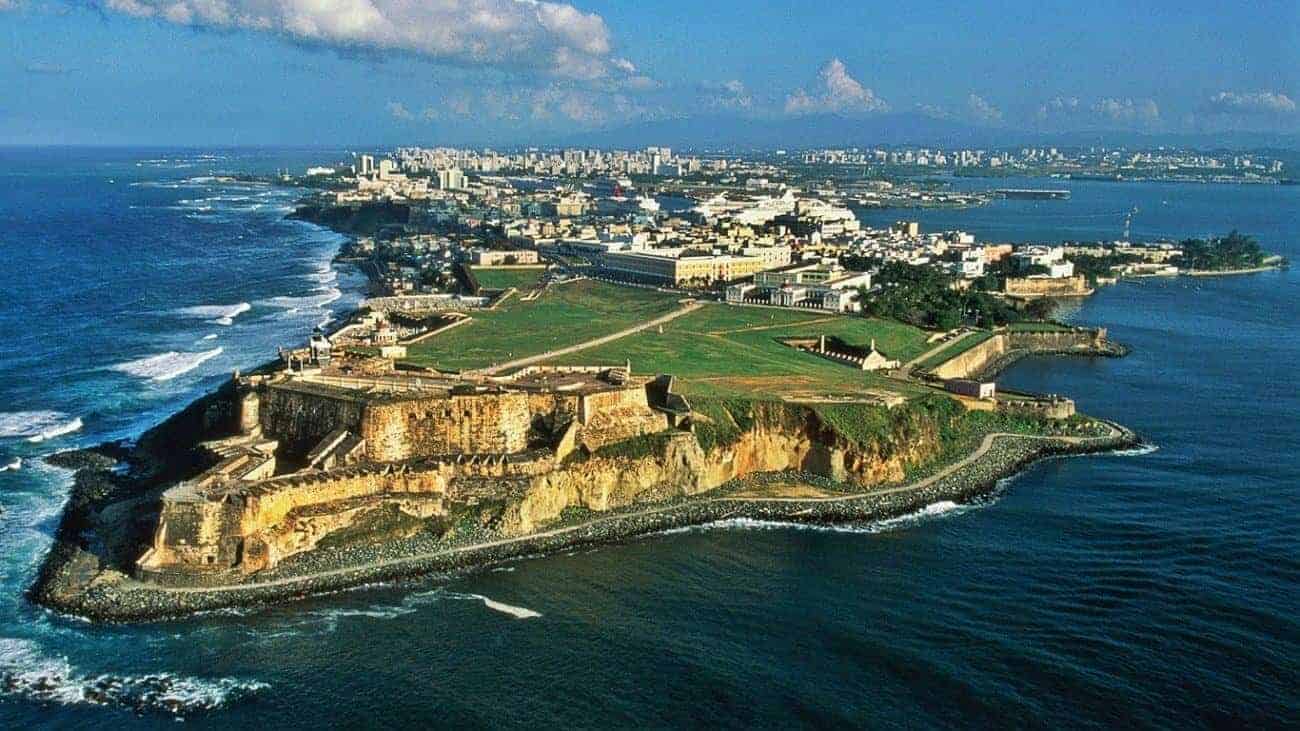
The landscape is shaped by a mountain range that runs through the island from east to west and peaks at Cerro de Punta at 1,338 m. Several small rivers flow down from the dormant volcanoes and provide fertile soil for fields of sugar cane, coffee and tobacco. The coastline is marked by beautiful sandy beaches almost all the way around the island.
Best time to travel to Puerto Rico
Puerto Rico has a tropical climate with warm temperatures all year round, and the difference between the seasons is felt most in the rainfall. The dry period typically runs from December to April, and this is when most people choose to travel. The sea is warm, and rain rarely comes in long spells.
The wet season from May to November brings frequent but often brief showers, typically in the afternoon. It is also the hurricane season, which peaks in September and October. This is not an unknown phenomenon in the Caribbean, and it is worth keeping an eye on the weather forecast if you are planning a trip in that period. Your travel insurance should cover this risk.
If you want to avoid both the largest crowds and the most intense downpours, the shoulder seasons in April and May can be a good choice. Flight and hotel prices are often lower outside the peak periods around Christmas and Easter, but this varies from year to year, so always check current offers before you book.
How to get there
There are no direct flights from Denmark to Puerto Rico, so you should expect to change planes along the way. Most travellers from Denmark fly via a hub in the USA, typically New York or Miami, and then on to San Juan, which is the island’s international airport. The total travel time is often between ten and fourteen hours, depending on the connections and the waiting time between flights.
From the major American cities, San Juan is a relatively short flight, and there are many daily departures from the east coast. This is one of the places where the close ties with the USA make themselves felt in practice, including in the flight routes.
For travellers from Denmark, American entry requirements apply, because Puerto Rico is part of the USA. You need a valid passport, and it should be valid for the period you will be staying. Visa-free travel for Danish citizens requires an approved electronic travel authorisation, and the current requirements can change, so check the official information before departure. Also remember that the transit country, the USA, has its own entry controls, even if you are only changing planes.
Getting around the island
A car is the most flexible way to get around Puerto Rico. The island is not large, but road standards vary, and when you drive up into the mountains or out to the smaller coastal towns, it can be an advantage to have a car with good ground clearance. Many travellers hire a car directly at San Juan airport. Be aware that driving direction and road signage follow American standards.
Public transport exists, but it is limited. There are buses connecting the larger towns, but they do not run frequently, and the timetables can be hard to make sense of for someone who does not know the area. For San Juan and the nearby districts it can work well, but if your destination is far from the capital, you will almost always need a car or a taxi.
Taxis are available in San Juan and at the larger hotels, and one of the simplest options for short trips is to agree on the price before you get in. Trips out into the countryside to places such as El Yunque or the western beaches quickly become expensive by taxi, so here a hire car clearly makes the most sense. Expect the journey from the coast to the mountains to take a long time, because the roads wind considerably.
Puerto Rico in brief
The Free State is a self-governing territory with a special association with the United States, located in the north-eastern Caribbean.
Capital: San Juan
Area: 9,104 km²
Currency: US dollar
Population: 3.474 million (2015)
Continent: North America
Official languages: Spanish, English
Read more about the Caribbean
Here is the introductory page to the many beautiful islands of the Caribbean
Sailing holidays in the Caribbean. The incredible archipelago seen from the sea
Cruises in the Caribbean? The modern cruise is full of activities


